
Ground Beef Price Per Kg Canada 2026: What You’re Paying Now
Quick Answer
Ground beef reached $16.46 per kilogram in one recent 2026 Statistics Canada monthly reading, up from $12.31 per kilogram in 2021. That is a roughly 33.7% increase, and it explains why a basic family meal now feels noticeably heavier on the grocery bill. The pressure is not coming from one cause alone. It reflects tight cattle supply, gradual herd rebuilding, transport and fuel-related costs, processing labour pressure, and strong meat demand.
The national average is $16.46 per kg. Prices vary by store and type, from $13.49 at Costco to $24.89 at Sobeys
Relief is unlikely to come quickly. Canada’s cattle herd rose to 11.1 million head as of January 1, 2026, the first increase in years, but the herd is still rebuilding from a very low base. FCC’s 2026 cattle outlook says major herd rebuilding is not expected in 2026 and any expansion is likely to be gradual, keeping prices supported for the next few years.
Ground beef price by store in Canada (2026)
Here is a direct price comparison across major Canadian grocery stores as of May 15, 2026:
| Grocery store | Price per kg (CAD) | vs cheapest |
|---|---|---|
| CostcoLowest | $13.49 | — |
| No Frills | $14.99 | +11% |
| Real Canadian Superstore | $17.25 | +28% |
| Walmart | $19.82 | +47% |
| Metro | $22.69 | +68% |
| Loblaws | $24.22 | +80% |
| Sobeys / Safeway | $24.89 | +85% |
Prices surveyed online May 15, 2026 (Ontario); sale prices excluded and actual in-store prices may vary. The national average across all retailers was $16.46/kg. Source: store survey by Monetary Leaf.
🎧 Pressed for time? This summary covers why the ground beef price per kg Canada 2026 has hit $16.46 in 2026, and whether relief is actually coming.
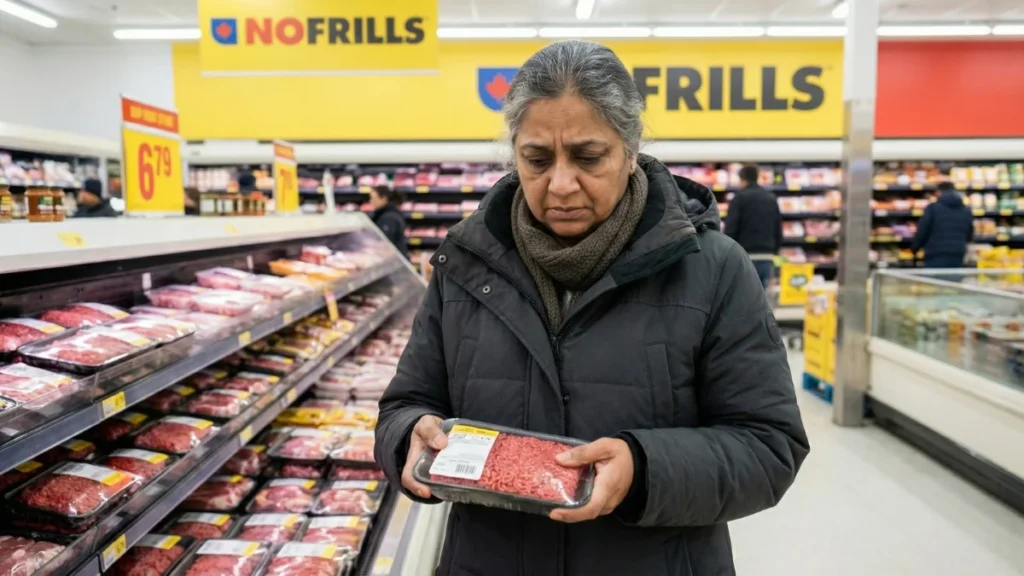
Priya stands in the meat aisle at the No Frills on Dundas, holding a family pack of lean ground beef in both hands like it’s something fragile. The sticker says $38.47. She puts it back. She picks up a smaller tray, 450 grams, and reads $8.60. She does the math in her head, tries to figure out how many tacos that actually makes for four people, and feels something close to embarrassment when she puts that one back too. She pulls out her phone, opens the Flipp app, and starts scrolling through flyers for the third time this week.
There’s a notification from the CRA sitting at the top of her screen, something about her next Canada Groceries and Essentials Benefit payment. Her family is set to receive nearly $1,890 this year. She did the math last weekend: that covers about 10% of her annual food bill. A drop in the bucket at these prices. It’s a Tuesday evening. She’s been at work since seven. Dinner isn’t even started.
Priya is 44, a medical office administrator in Brampton, married, two kids in high school. She and her husband bring in a decent combined income, somewhere north of $105,000. Five years ago, that felt comfortable. Now she meal-plans like it’s a second job and still can’t shake the feeling that she’s doing something wrong. She isn’t. The ground beef price per kg Canada 2026 has simply left the range that most families built their habits around, and the math doesn’t lie.
The headlines don’t match the cart
If you’ve been reading the business pages, you’ve seen the good news. Inflation is cooling. The Bank of Canada has been holding steady. The worst is supposedly behind us. And yet Priya’s grocery bill keeps climbing. She spent $247 last week on what used to be a $170 shop, and ground beef was a big part of the difference.[Related: Why Are Groceries So Expensive in Canada?]
This is the gap that drives people quietly nuts. The official story says things are stabilizing, but nobody told the meat counter. The national average for regular ground beef is now $16.46 a kilogram. Lean ground beef is closer to $19.00. In Ontario, where Priya shops, lean at a Loblaws or Metro regularly hits $18.72 to $19.00 per kilogram. Extra-lean can push past $23.
These aren’t sale prices. These are Tuesdays.
How much have ground beef prices risen since 2021?
The price didn’t creep, it jumped.
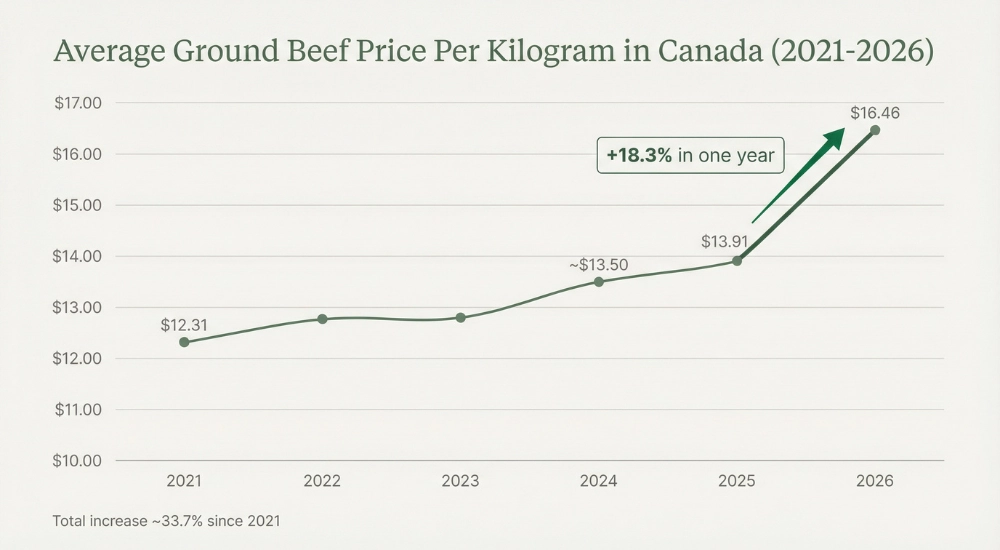
The numbers become sharper when you line them up over time. In early 2021, ground beef averaged $12.31 per kilogram nationally. By 2024, it had crept up to about $13.50. Then the floor dropped out. Between 2025 and early 2026, the price jumped from $13.91 to $16.46. That’s an 18.3% spike in a single year, and a total increase of roughly 33.7% since 2021.
That kind of movement doesn’t just sting at the register. It rewires how families eat. Priya used to buy two kilograms of lean ground a week without thinking twice. Now she buys one, stretches it with oats and lentils, and still feels like she’s spending more than she used to.
The national grocery basket has hit $692.50, up 5.7% year-over-year, and meat is doing most of the heavy lifting. In Ontario, grocery inflation is running at 6.9%, well above the national average. For a family of four, the expected annual food bill in 2026 is around $17,572. That’s nearly a thousand dollars more than last year. (Data sourced from Canada’s Food Price Report 2026)
Ground beef prices by province in Canada
Lean ground beef prices per kilogram across Canadian provinces
Where you live changes what you pay, but not by as much as you’d hope.
British Columbia is the most expensive province for fresh protein, with ground beef often north of $17.20 per kilogram and a total grocery basket topping $735. Alberta, despite being the heart of the Canadian cattle market, doesn’t offer the discount you’d expect. Regular ground beef there averages about $15.85. The reason is simple: Alberta beef sells internationally, and strong export demand keeps domestic prices from dropping much. Quebec sits a bit lower at $15.22 for regular, partly due to different retail competition.
Nova Scotia deserves special mention. Grocery inflation there is running at 8.5%, the highest in the country. Regular ground beef averages $16.85 per kilogram, and lean is approaching $19.40. For families in Halifax and across rural Nova Scotia, it’s getting hard to keep up.
Priya’s parents retired to Barrie last year. They told her over the phone that they’ve started eating ground beef once a month instead of once a week. She could hear the embarrassment in her mother’s voice. Nobody in the family talks about it directly, but everyone’s noticed.
Why is ground beef so expensive in Canada?
Factors Influencing Canadian Ground Beef Market Prices 2026
The price isn’t high because of one thing. It’s high because of several things happening at the same time, and none of them are quick to fix.
The biggest driver is the cattle herd. Years of drought across Western Canada and the U.S. plains forced ranchers to sell off breeding stock they couldn’t afford to feed. By early 2025, the Canadian herd had shrunk to its smallest size in nearly four decades. As of January 2026, there’s been a small recovery, about 2.5%, bringing the total to 11.1 million head. But here’s the catch: rebuilding a herd means keeping young heifers for breeding instead of sending them to slaughter. That actually tightens supply further in the short term. A calf born this spring won’t reach market weight for another 18 to 24 months. The shortage of Canadian beef is real, and biology sets the timeline.
On top of that, the industrial carbon price rose to $110 per tonne on April 1, 2026. That hits every refrigerated truck hauling beef from Alberta to the GTA. One estimate from the Agri-Food Analytics Lab at Dalhousie pegs the carbon cost for a single truck running between Toronto and Montreal once a week at about $6,000 a year, triple what it was in 2022. Add in the clean fuel regulation, which tacks roughly 7 cents a litre onto diesel, and every link in the supply chain costs more.
Priya’s husband pointed out that the federal consumer fuel charge got cancelled under Bill C-4. He figured it would help. And it did, a little, at the pump. But the meat counter hasn’t moved, because the consumer carbon tax was never the main force behind beef prices. Even when pump prices fall, meat prices may not follow right away. Here’s why lower gas prices do not quickly lower grocery prices.
The herd shortage and the biological timeline are. The industrial carbon levy, the one that touches refineries, trucking, and refrigeration at every stage, is still climbing. That’s the one families feel at the grocery store, even if they never see it on a receipt.
Labour is another piece. Reforms to the Temporary Foreign Worker Program have capped low-wage positions at processing plants, and plants in Alberta and Ontario are either paying more for domestic workers or running under capacity. Both outcomes push costs up.
And then there’s the retail layer. In early 2026, investigations found that major chains including Loblaws, Sobeys, and Walmart had been including packaging weight in the net weight of meat products, overcharging shoppers by 4% to 11%. A proposed class-action lawsuit followed in Manitoba. For families already stretched thin, discovering that the price tag might not even be honest is the kind of detail that breeds a deep, slow-burning mistrust.
How to save money on ground beef in 2026
Best Deals on Ground Beef per Kilogram in Canada 2026
Priya doesn’t have a deep freezer. She doesn’t have the upfront cash to buy a half-cow from a local farm, and she doesn’t have time to drive to three different stores every week. She’s heard all the suggestions. She’s tired of them.
But a few things actually work within her reality.
- Family packs still offer a per-kilogram discount of about $2 to $3 compared to smaller trays. A 1.8 kg value pack of lean ground at Metro runs about $19.90 per kilogram, compared to $22.20 for the 450-gram tray. The catch is the upfront price tag. That Metro pack costs roughly $35 to $36. Priya’s workaround: she buys one every other week and portions it into freezer bags the same night.
- Walmart’s “Your Fresh Market” brand consistently comes in at $16.60 per kilogram for regular ground. It’s not lean, but for recipes where fat gets drained anyway, it does the job.
- Flashfood, the app that sells near-expiry grocery items at a steep discount, has become a legitimate tool. Ground beef shows up often, sometimes at 50% off, and Priya checks it every evening. It’s not reliable enough to plan a week around, but it fills gaps.
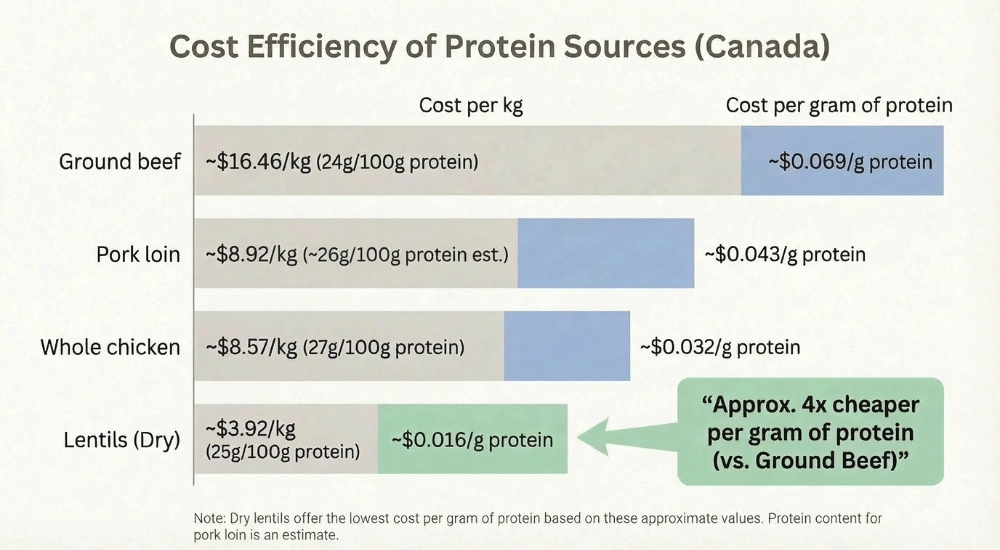
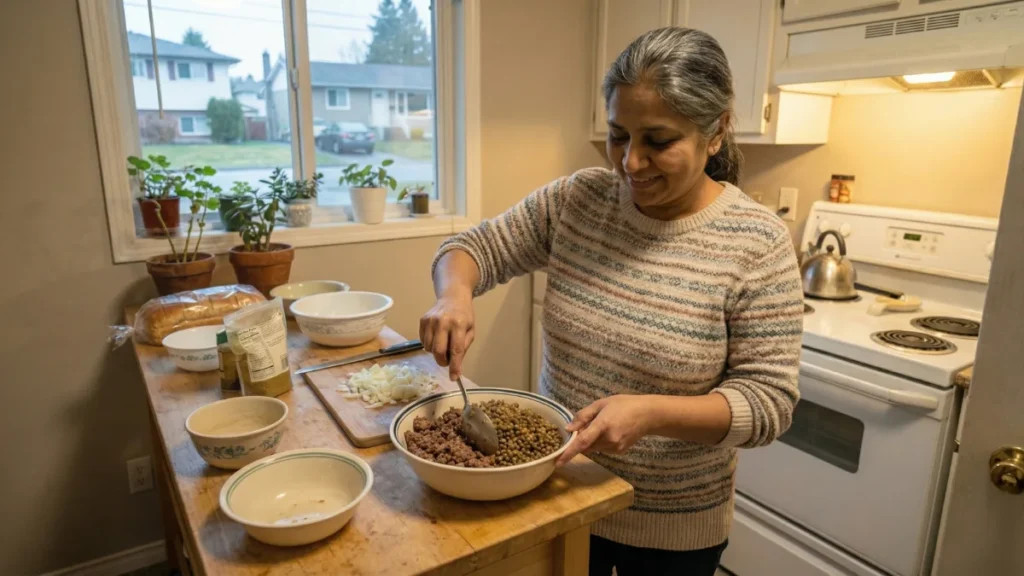
- The protein math also matters. Dry lentils cost about $3.92 a kilogram and deliver 25 grams of protein per 100 grams. Ground beef, at $16.46, delivers 24 grams. On a cost-per-gram-of-protein basis, lentils are more than four times cheaper. Priya’s started mixing half a cup of cooked lentils into every batch of taco meat. Her kids haven’t complained. She hasn’t told them.
- A whole chicken at $8.57 per kilogram gives you 27 grams of protein per 100 grams. That’s the best deal in the meat section right now. Pork loin, at $8.92 a kilogram, is close behind. Neither replaces ground beef in every recipe, but they go a long way toward stretching the weekly protein budget.
One thing that surprises people: canned chickpeas are actually more expensive than ground beef per gram of protein, because most of the can weight is liquid. If you’re going plant-based for cost reasons, buy dry. [Related: Why Is Everything So Expensive in Canada?]
Is chicken or pork cheaper than ground beef now?
The usual escape valve when beef gets expensive is chicken. Families switch, demand shifts, and prices find a new balance. That hasn’t happened this time. Whole chicken prices surged 43.8% recently, which means the substitute is inflating right alongside the original problem. Pork has climbed too. Grocery inflation Canada 2026 isn’t a one-aisle problem. It’s the entire protein section.
Dairy has become another pressure point, especially for families buying milk, butter, cheese, and yogurt every week.
April 2026 StatCan data makes the shift concrete: ground beef at $16.46 per kilogram is now officially $2.00 more expensive than chicken breast at $14.46 per kilogram. Five years ago, ground beef was the cheaper option. That flip would have been unthinkable to Priya’s mother, who built a whole week of family dinners around it. The “cheap staple” isn’t cheap anymore. It costs more than the protein most people used to trade up to.
That’s why 2026 feels different. There’s no cheap fallback. Every animal protein is more expensive than it was two years ago, and the pressure lands hardest on families who were already spending the largest share of their income on food.
Priya noticed it when she tried switching to chicken thighs for a month. The savings were real but smaller than she expected, and her son started asking why they never have burgers anymore. She went back to ground beef once a week, mixed with lentils, and accepted the cost. Sometimes the emotional math matters as much as the financial math.
The Weight Nobody Talks About
The part that doesn’t show up in any price chart is the mental load. Priya spends hours each week comparing flyers, checking apps, adjusting recipes, and doing mental arithmetic in the aisle. She’s not alone. Surveys suggest 86% of Canadians have cut back on meat, but only 17% have fully replaced it with plant-based alternatives. Most people are just eating less, eating differently, and trying not to think too hard about what that means.
There’s a particular kind of shame that comes with struggling to afford food in a country that raises cattle. People feel like they should be able to manage. They blame themselves for not being better at couponing, for not meal-prepping on Sunday, for not driving to the discount store across town. Online, the advice is endless and often unkind. “Just buy a half-cow.” “Just eat less meat.” “Just learn to cook.” As if the problem were ignorance and not arithmetic.
The question of grocery rebate eligibility 2026 comes up often in these conversations, with families trying to figure out if they qualify for any federal relief. For most middle-income households, the answer is no, or not enough. The support that exists targets lower-income brackets, which leaves a wide band of families earning too much to qualify and too little to absorb the hit comfortably.
Priya doesn’t talk about grocery stress with her friends. She assumes they’re managing better. They probably assume the same about her.
Ground Beef Price Forecast Canada 2026
The honest outlook: don’t expect relief soon.
The Canadian cattle market outlook points to a long rebuild. That 2.5% herd increase is a necessary first step, but prices aren’t likely to ease before mid-2027 at the earliest. Heifer retention will keep supply tight through this year and into next. International calf imports surged 42.7% in late 2025, which tells you producers are trying to speed things up, but imported stock brings its own costs, including transportation and currency risk.
Trade uncertainty doesn’t help. Ongoing disputes with the United States and the new European carbon border tariffs add volatility to a market that already has very little room to absorb shocks. The Bank of Canada’s 2.5% interest rate environment means borrowing costs for farm expansion are still higher than they were before the pandemic, which slows the pace of rebuilding.
On the retail transparency side, the Grocery Code of Conduct and new front-of-pack labelling mandates may force better practices. That’s worth something, but it won’t lower the cost of raising a calf.
The realistic expectation is that ground beef prices will stay at or near their current plateau for at least another 12 to 18 months, and that any meaningful decline, if it comes, will be gradual.
What Hasn’t Changed
Priya made tacos last Thursday. She used 400 grams of regular ground beef, a cup of cooked red lentils, and the same seasoning she’s always used. Her daughter asked for seconds. Her husband didn’t notice the difference, or if he did, he didn’t say anything.
She spent less than she would have two years ago on a full kilogram of beef, and the meal fed everyone. It wasn’t the version of dinner she grew up making, but it was good. It was enough.
The ground beef price per kg Canada 2026 has changed what a weeknight meal costs, but it hasn’t changed Priya’s ability to think clearly, to adapt, and to feed her family well. The financial ground has shifted under all of us. Price per pound versus price per kilogram, regular versus lean, family pack versus single tray, lentils versus beef: these are the small daily calculations that millions of Canadians are making right now, quietly and without recognition.
You’re not doing it wrong. The math just changed. And you’re allowed to be tired of it.
Key Facts
- National average for regular ground beef: Statistics Canada data shows ground beef at $16.46/kg in one recent 2026 monthly reading.
- Total increase since 2021: Using Statistics Canada data, ground beef rose from $12.31/kg in 2021 to $16.46/kg in a 2026 reading, a roughly 33.7% increase.
- Canadian cattle herd: Canadian cattle producers held 11.1 million cattle and calves on January 1, 2026, up 2.5% from one year earlier.
- Herd rebuilding: FCC does not expect major Canadian herd rebuilding in 2026, and says any expansion will likely be gradual.
- Annual food bill: Canada’s Food Price Report 2026 estimates that a family of four will spend $17,571.79 on food in 2026, up $994.63 from last year.
- Ground beef vs chicken breast: In one recent Statistics Canada monthly reading, ground beef was $16.46/kg while chicken breasts were $14.46/kg, making ground beef about $2.00/kg higher in that month.
- Whole chicken pressure: Statistics Canada data shows whole chicken at $8.57/kg in one early 2026 monthly reading, while media analysis reported a 43.8% year-over-year jump.
- Meat reduction behaviour: Canada’s Food Price Report 2026 says 86% of consumers reported eating less meat because of high prices, while 17% reported increasing plant-based protein consumption.
- Canada Groceries and Essentials Benefit: For eligible low- and modest-income households, a family of four could receive up to $1,890 in 2026, which equals roughly one-tenth of the Canada Food Price Reports’ estimated annual food bill for a family of four.
- Meat weighing concern: A CBC News investigation found underweighted meat packages at several major grocery stores, with calculated overcharges ranging from 4% to 11% in tested items.
Frequently Asked Questions
What is the average price of ground beef per kilogram in Canada in 2026?
The national average for regular ground beef is about $16.46 per kilogram as of early 2026. Lean ground beef runs closer to $18.90 nationally, with prices varying by province and retailer. Ontario and British Columbia tend to sit above the national average, while Quebec is slightly below.
Why is ground beef so expensive in Canada right now?
The main driver is a historically small cattle herd, the result of years of drought that forced ranchers to sell breeding stock. Rebuilding takes years because of the biological timeline of cattle production. Rising carbon pricing on transportation, labour shortages at processing plants, and the simultaneous inflation of chicken and pork have all added pressure.
Will ground beef prices come down in 2027?
Most analysts expect prices to stay near current levels through at least mid-2027. The herd is beginning to recover, but calves born now won’t reach market weight for 18 to 24 months. Any relief will likely be gradual rather than sudden.
What’s the cheapest way to get protein in Canada in 2026?
Dry lentils and other pulses offer the best value per gram of protein, at roughly one-quarter the cost of ground beef. Whole chicken and pork loin are the most affordable animal proteins. Mixing ground beef with cooked lentils in recipes like tacos, chili, or meatloaf can cut costs by 15% to 30% per meal without a dramatic change in taste.
Are family packs of ground beef still worth buying?
They still offer a per-kilogram discount of $2 to $3 compared to smaller trays, but the upfront cost of a single pack can be $35 to $40. If you have freezer space and can portion the meat the same day, they remain one of the better deals at the grocery store. Just double-check the net weight, as recent investigations found some retailers were including packaging weight in the price.
Disclaimer:
This article is for informational and educational purposes only and does not constitute financial, legal, tax, or investment advice. Individual circumstances vary, so please use your own judgment and consult a qualified professional when appropriate.