Gas Tax Canada 2026: Why Pump Relief Hasn’t Reached Grocery Bills
Quick Answer
The gas tax in Canada dropped because the federal government suspended its fuel excise tax on April 20, 2026, cutting 10 cents per litre off gasoline and 4 cents off diesel. Pump prices can adjust within hours because fuel is priced in near-real time and stations compete openly on visible signage. Grocery prices don’t work that way. They move through slower systems: diesel freight contracts, supplier pricing agreements, warehouse inventory, wholesale cycles, packaging costs, refrigeration, labour, and retailer decisions that take weeks or months to shift. The gas tax holiday may eventually ease some upward pressure on food costs, but families should not expect a matching drop at the checkout.
🎧 Pressed for time? Listen to a summary of the heart of this story. Full data and guidance are detailed in the article below.
Marianne noticed it on a Sunday morning at the Petro-Canada on Upper James. The price board read $1.69. She did the math in her head while the nozzle clicked. That was almost a five-dollar difference on a full tank compared to two weeks ago. Her husband, Dale, would be pleased. He’d been talking about the federal gas tax holiday since the news broke, checking pump prices the way he used to check hockey scores.
She drove straight to Fortinos after. Same list she always carries folded in her jacket pocket: chicken thighs, cheddar, a bag of apples, bread, eggs, two litres of milk, a box of granola bars for the kids’ lunches. She moved through the aisles the way she always does, scanning unit prices, comparing sizes, skipping anything that looked like it had crept up again. At checkout, the total was $114. Almost exactly what it had been the week before. And the week before that.
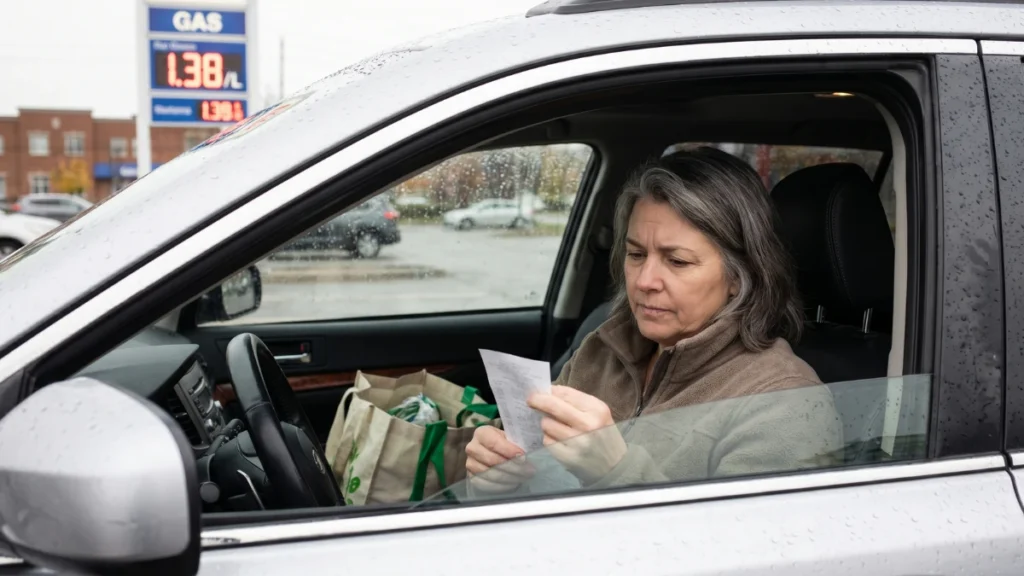
She sat in the car for a moment, receipt in her lap, and thought about what Dale would say. Gas is cheaper. Groceries aren’t. She didn’t know how to explain why, and she wasn’t sure anyone on the news could either.
Why the Pump Price Fell Overnight
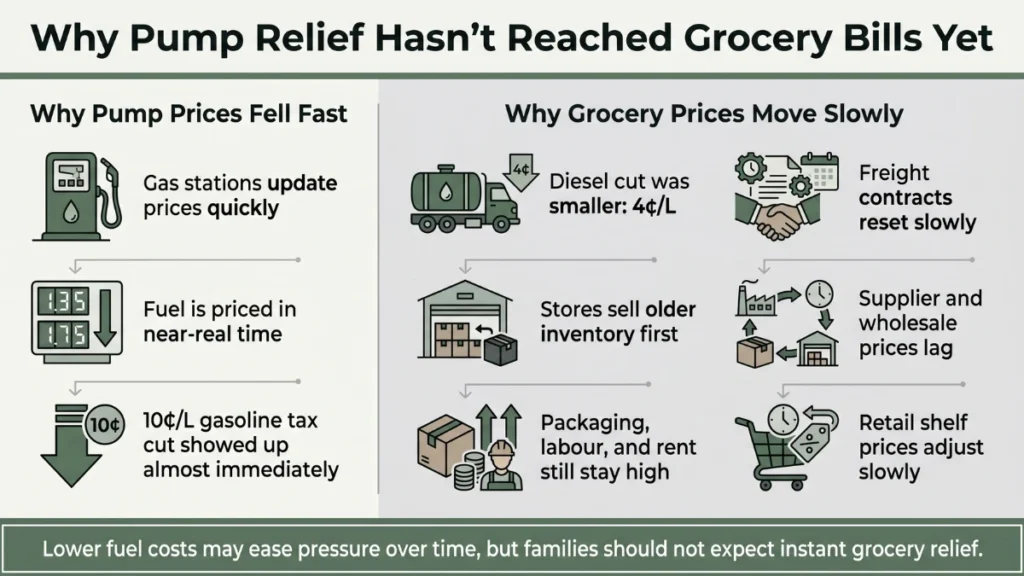
When the federal fuel excise tax was suspended at midnight on April 20, every gas station in the country faced the same competitive pressure: drop the price or lose volume to the station across the street. Gasoline is a near-identical product no matter where you buy it. Drivers will cross an intersection for two cents a litre. That kind of price sensitivity means tax cuts flow through to the pump almost instantly.
In Ontario, the math was slightly better than the raw 10-cent cut. Because HST is calculated on the total price at the pump, including taxes, the actual reduction came closer to 11.3 cents per litre once the cascading sales tax was removed from that portion. For a family filling up a minivan once a week, that works out to roughly $6 to $8 per fill, or about $25 to $30 a month.
For a plain-language look at what actually goes into the pump price, including fuel cost, margins, federal tax, provincial tax, and sales tax, read our guide to gasoline price breakdown in Canada.
Marianne and Dale could see it. They could feel it. The pump price was lower, and nobody had to explain how or when or whether it would “trickle down.” It was just there, on the sign, in real time.
Groceries don’t have signs like that.
Canada Fuel Tax: What’s Actually in a Litre
One reason so many Canadians are frustrated is that fuel taxes are genuinely confusing. There are layers. The federal fuel excise tax, now temporarily suspended, was 10 cents per litre on gasoline. The federal carbon price, which added up to 18 cents per litre in some provinces, was cancelled in April 2025. Provincial fuel taxes vary wildly, from about 6 cents in the Yukon to 27 cents per litre in Vancouver. Then the GST or HST is applied on top of all of it.
So when someone in Hamilton hears “gas tax holiday,” they might assume all taxes on fuel have been paused. They haven’t. The federal excise tax is suspended. Provincial taxes remain. Sales tax remains. And the carbon price is a separate policy that was already eliminated a year ago.
This matters because some Canadians feel the relief should be bigger than it is. And the confusion feeds the sense that someone, somewhere, is keeping the savings.
Gas Tax vs Carbon Tax Canada
The federal gas tax and the carbon tax are not the same thing, even though both affected the price at the pump.
The carbon tax was a climate policy. It was designed to make fossil fuel use more expensive as a way to encourage lower-carbon choices. It was cancelled in April 2025. The federal fuel excise tax is a revenue-generating tool that has been in place since the mid-1990s. It has nothing to do with climate policy. The April 2026 gas tax holiday suspends this excise tax, not the carbon levy, which no longer exists.
The timing of the two changes, roughly a year apart, has blurred them together in public conversation. But they are separate policies with separate purposes, and the current relief comes from the excise suspension alone.
Why Groceries Don’t Follow the Pump
Here is where the frustration gets real for people like Marianne, who can see one price falling and can’t understand why the other won’t move.
Gasoline is one product, sold in one format, priced in near-real time. A grocery store carries tens of thousands of products, each with its own supply chain, its own contracts, its own shelf life, and its own pricing logic. There is no single lever that lowers everything at once.
More importantly, the gas tax holiday cut diesel by only 4 cents per litre, not 10. Diesel is the fuel that actually moves food. It powers the trucks from the farm to the processing plant, from the plant to the distribution centre, and from the centre to the store. A 4-cent diesel cut on a truck burning hundreds of litres per trip is real money for carriers, but it doesn’t dramatically change the cost of shipping a pallet of bread across Ontario.
And that 4-cent savings doesn’t arrive at the grocery shelf the next day. It moves through freight contracts that are often set monthly or quarterly. Carriers frequently include fuel surcharges based on rolling averages, not yesterday’s price. Many logistics companies hedged their fuel costs months in advance, which means they’re still burning fuel they effectively “bought” at pre-holiday rates.
Then there’s the inventory already sitting in the store. The chicken Marianne picked up this Sunday was trucked to Fortinos days or weeks ago, when diesel was more expensive. Grocers use a first-in, first-out system: they sell the older, more expensive stock before the newer, cheaper stock ever reaches the shelf. That cycle alone can take weeks.
Dairy prices show the same delay, because farmgate prices, processing, refrigeration, packaging, and retailer decisions all sit between the farm and the shelf.
The Real Cost Chain Behind a Grocery Receipt
Fuel isn’t just a shipping expense. It’s embedded at every stage. Farmers run diesel tractors and combines. Fertilizer production depends on natural gas, and fertilizer costs have risen sharply in 2026. Processing plants use electricity and heat. Packaging relies on petroleum-based plastics. Refrigerated trucks, the ones that carry meat, dairy, and produce, cost roughly 30 percent more to run than dry freight because the engine has to power a cooling unit in addition to the wheels.
In northern and remote communities, the math is even harder. Food flown in by air faces aviation fuel surcharges that can add 50 cents per pound. The federal holiday cut aviation fuel tax by 4 cents per litre, which barely registers against that kind of cost.
A 4-cent diesel cut at the pump does not erase a 70 percent increase in fertilizer costs, or the rising price of plastic packaging, or the weak Canadian dollar making imported produce more expensive. Food prices are not just “fuel plus a markup.” They are dozens of cost inputs stacked together, and fuel is only one of them.
Where the Squeeze Shifts
Marianne has already noticed the shifts, even if she doesn’t use economic language to describe them. Chicken thighs used to be the budget protein in Canada. Now she watches those prices, too, and sometimes switches to lentils or canned beans without telling the kids. Frozen fruit has replaced fresh berries in the smoothies she makes on weekday mornings. She buys the No Name cheddar instead of the brand she grew up eating.
These aren’t dramatic choices. They’re the quiet math that millions of Canadian households are running every week. The overall grocery bill hasn’t gone down. What’s changing is what’s inside the bags.
Fresh produce, in particular, has been hit by the combination of transport costs, a weaker loonie hovering around 73 cents U.S., and the fact that Canada imports nearly half of its fresh fruits and vegetables during the colder months. Frozen and canned alternatives absorb less of those transport and currency pressures, which is why they’ve become the practical fallback for careful shoppers.
How Households Are Actually Adjusting

Nobody in Marianne’s circle is waiting for grocery prices to drop. They’ve stopped expecting that.
Instead, the adjustments are constant and small. Shopping from the front page of the digital flyer first, then filling in the gaps. Buying private-label brands almost exclusively. Checking the weight on packaged meat, after the reports about some major retailers overcharging on underweight packages. Stretching meals with rice, pasta, and root vegetables. Consolidating car trips to use less gas even with the lower price. Redirecting a few dollars of pump savings toward the grocery bill, not as a strategy someone told them to follow, but because that’s where the pressure is.
Some families have started treating the gas savings like a small monthly cushion, somewhere between $15 and $30, that goes directly toward the next grocery run. It isn’t transformative. But it’s something tangible in a landscape where very little else has moved in their favour.
Why the Pressure Doesn’t Let Up
The structural picture helps explain why this isn’t going away quickly. Canada’s food inflation rate hit 7.3 percent in early 2026, the highest in the G7. Grocery prices have climbed more than 30 percent since 2019, well above the roughly 17 percent that would have been expected based on pre-pandemic trends. The Canadian dollar has weakened, making imports costlier. The country’s vast geography means transportation is a larger share of the final food price than it is in the U.S. or most of Europe. And Canada’s grocery market is highly concentrated, with a small number of major chains controlling a large share of retail food sales.
None of this is the fault of the person standing at the checkout wondering where the relief is. For many families, this is part of the wider question of why everything still feels expensive in Canada even when some headline numbers look better.
The Competition Bureau has said that grocery margins sit around 3.5 percent, and that retailers are largely passing through cost increases from manufacturers and wholesalers. That doesn’t mean every pricing decision is fair, and the recent investigations into meat-weight practices have understandably damaged public trust. But the idea that grocers are simply pocketing the diesel savings while shoppers suffer is too simple an explanation for a problem this layered.
What It Actually Feels Like
The hardest part isn’t any single price increase. It’s the accumulation. Marianne doesn’t lose sleep over eggs costing 40 cents more than last year. She loses sleep over the fact that eggs cost more, and cheese costs more, and bread costs more, and apples cost more, and school snacks cost more, and hydro costs more, and the property tax notice came in higher, and the car insurance went up, and the kids need new shoes again.
Each line item is survivable on its own. Together, they create a kind of financial fatigue that’s hard to describe to anyone who isn’t living it. It isn’t panic. It’s a low, steady weight. The feeling of doing everything right, being careful, making the substitutions, clipping the digital coupons, choosing the smaller size, and still watching the total climb. This is the same quiet pressure many responsible households feel in midlife: doing everything right, yet still falling behind.
When the gas tax holiday was announced, there was a brief moment of hope. Not excitement, exactly, but the sense that maybe something was finally going to ease. And then the grocery bill came in the same as before, and the moment passed.
That gap between what was promised and what was felt is where the real frustration lives.
Key Facts
- The federal gas tax holiday runs from April 20 to September 7, 2026, cutting 10 cents per litre from gasoline and 4 cents per litre from diesel.
- The estimated cost to the federal treasury is $2.4 billion.
- Canada’s average gas price fell from about $1.74 per litre last week to about $1.69 per litre on April 20, when the tax holiday took effect.
- Overall food inflation in Canada reached 7.3 percent in January 2026, while grocery-store prices rose 4.8 percent year over year.
- A Canadian family of four is projected to spend approximately $17,572 on groceries in 2026.
What Comes Next
Food price researchers have suggested that food inflation may ease somewhat in the second half of 2026 as freight contracts begin to reflect lower diesel costs and global energy markets stabilize. But the expectation is for a slowing of increases, not a reversal. Prices that have already risen are unlikely to fall back to where they were. A prominent food economist has put the likely range at 5 to 6 percent food inflation for the foreseeable future, noting that volatility in energy markets keeps transportation companies bidding high on contracts to protect themselves.
The federal government has introduced the Canada Groceries and Essentials Benefit, an expanded version of the GST/HST credit, with a one-time top-up scheduled for June 5, 2026. For a family of four with $40,000 in household income, that top-up is estimated at $533, with an additional quarterly increase of about $272 per year. It won’t eliminate the squeeze. But for households running tight, it’s a concrete number to plan around.
The gas tax holiday expires on September 7, just after Labour Day. What happens after that depends on energy markets, the geopolitical situation, and whether the government extends the suspension. For now, the smart expectation is to treat the pump savings as temporary and the grocery pressure as ongoing.
Your Household Cost Comparison
| Household Cost | What Changed After the Gas Tax Holiday | Why the Bill May Not Fall Right Away | What to Watch |
|---|---|---|---|
| Filling the family car | 10 cents per litre cut plus HST savings; visible immediately at the pump | N/A, this one did fall | Weekly pump price in your area |
| Weekly grocery shop | Diesel cut of 4 cents per litre may reduce freight costs over time | Inventory cycles, freight contracts, and wholesale agreements take weeks or months to adjust | Flyer prices on staples; private-label vs brand-name gaps |
| Food delivery and freight | Carriers pay less per litre of diesel | Fuel surcharges are based on rolling averages, not daily prices; many contracts are locked quarterly | Whether carriers begin lowering surcharges by mid-summer |
| Meat and dairy | Transport costs may ease slightly | Cold-chain trucking is 30% more expensive than dry freight; feed and processing costs remain high | Price per kilogram on chicken, beef, and cheese |
| Produce | Some transport savings possible | Nearly half of fresh produce is imported; weak loonie offsets fuel savings; seasonal pricing dominates | Frozen vs fresh price gap; watch for summer local-produce season |
| Packaged foods | Minimal impact expected | Packaging uses petroleum-based plastics still tied to high crude prices; processing uses electricity, not diesel | Unit prices on cereal, snacks, and canned goods |
That is why many shoppers now watch the ground beef price per kilogram in Canada more closely than they used to.
What Marianne Already Knows
Marianne isn’t waiting for a headline to tell her things are getting better. She’s already adjusted. She’s been adjusting for three years. The gas tax holiday put a few extra dollars back in her pocket at the pump, and she’s grateful for that in the plain, unsentimental way that careful people are grateful for small things.
She doesn’t expect the grocery bill to follow. She’s learned that prices go up on an escalator and come down on the stairs, if they come down at all. What she wants, more than a discount, is to stop feeling like the rules keep changing while she’s trying to play by them.
If you’re reading this and you recognize that feeling, it’s worth knowing: the gas tax Canada changed because the cost of energy became unsustainable for households, and the government acted on the most visible pressure point. Grocery prices haven’t followed because they move through a slower, more complicated system that doesn’t respond to a single tax lever. That doesn’t make the gap fair. It just makes it explainable.
You’re not imagining the squeeze. You’re not bad with money. The math has changed, and you’re doing the work of recalculating every week. That’s not failure. That’s the hardest kind of competence. For households trying to rebuild after years of rising costs, the next step is not panic. It is a calmer plan to recover financially in your 50s.
Frequently Asked Questions
What is the gas tax in Canada?
The federal fuel excise tax in Canada was 10 cents per litre on gasoline and 4 cents per litre on diesel before the April 2026 holiday. Provincial fuel taxes vary by region, ranging from about 6 cents to 27 cents per litre depending on where you live. GST or HST is also applied on top of all other taxes at the pump.
What changed with the April 2026 federal gas tax holiday?
The federal government suspended the fuel excise tax from April 20 to September 7, 2026, removing 10 cents per litre from gasoline and 4 cents from diesel. This was prompted by a global energy crisis that pushed Canadian pump prices above $1.74 per litre. The measure is expected to cost the federal treasury approximately $2.4 billion.
Is the gas tax the same as the carbon tax?
No. The federal carbon price was a separate climate policy that added up to 18 cents per litre in some provinces. It was cancelled in April 2025. The federal fuel excise tax is a long-standing revenue tool unrelated to climate policy. The April 2026 holiday suspends the excise tax, not the carbon levy, which no longer exists.
Why did gas prices fall faster than grocery prices?
Gas stations compete on visible, real-time pricing and can adjust within hours. Grocery prices move through multiple layers: diesel freight contracts, supplier agreements, warehouse inventory cycles, wholesale pricing, processing costs, and retailer decisions. Each layer adds delay. A 4-cent cut on diesel takes weeks or months to filter through these systems, if it filters through at all.
Will the gas tax holiday lower grocery prices?
It may reduce some upward pressure on food costs over time, but households should not expect a noticeable drop at the checkout. Diesel received only a 4-cent cut compared to gasoline’s 10-cent cut, and transportation is only one of many cost inputs for food. The most realistic expectation is that grocery price increases may slow slightly, not that shelf prices will fall.
Why are groceries still expensive if gas prices went down?
Because the forces driving grocery prices higher go well beyond fuel. Food inflation in Canada reached 7.3 percent in early 2026 due to a combination of high fertilizer costs, a weak Canadian dollar, reliance on imported produce, rising packaging costs, and the country’s vast transportation distances. A 4-cent diesel tax cut does not offset these broader pressures, and existing inventory was purchased and shipped at higher costs before the holiday began.
Disclaimer:
This article is for informational and educational purposes only and does not constitute financial, legal, tax, or investment advice. Individual circumstances vary, so please use your own judgment and consult a qualified professional when appropriate.