
Canada Gas Price Breakdown: Taxes & Why It’s High 2026
Quick Answer
Understanding Canada gasoline price breakdown and taxes 2026 means looking beyond fuel plus one tax. The price you pay at the pump in 2026 is shaped by global crude oil costs, refining margins, fixed provincial and federal fuel taxes, percentage-based sales taxes, and in some cities, regional transit levies. The federal excise tax on gasoline is temporarily suspended from April 20 to September 7, 2026.
The consumer carbon tax was removed in 2025. But a regulatory compliance cost from the Clean Fuel Regulations still adds to prices quietly. Prices differ across provinces because tax rates, sales tax systems, distance from refineries, and local competition all vary. A tax cut does not always produce a matching drop at the pump because other costs can rise at the same time.
🎧 Pressed for time? This summary covers the Canada gasoline price breakdown and taxes in 2026, including why a tax cut doesn’t always mean a lower price at the pump.
A litre of gasoline in Canada is not simply the cost of fuel plus a single tax. The pump price in 2026 is built from several layers: crude oil costs, refining and wholesale margins, distribution, a retail margin, federal fuel tax, provincial fuel tax, sales tax, and sometimes regional charges that apply only in certain cities. Understanding Canada’s gasoline price breakdown and taxes 2026 picture means seeing each of those layers and how they move.
If you have ever looked at your receipt and wondered where all that money goes, you are not alone.
What Makes Up Gas Prices in Canada
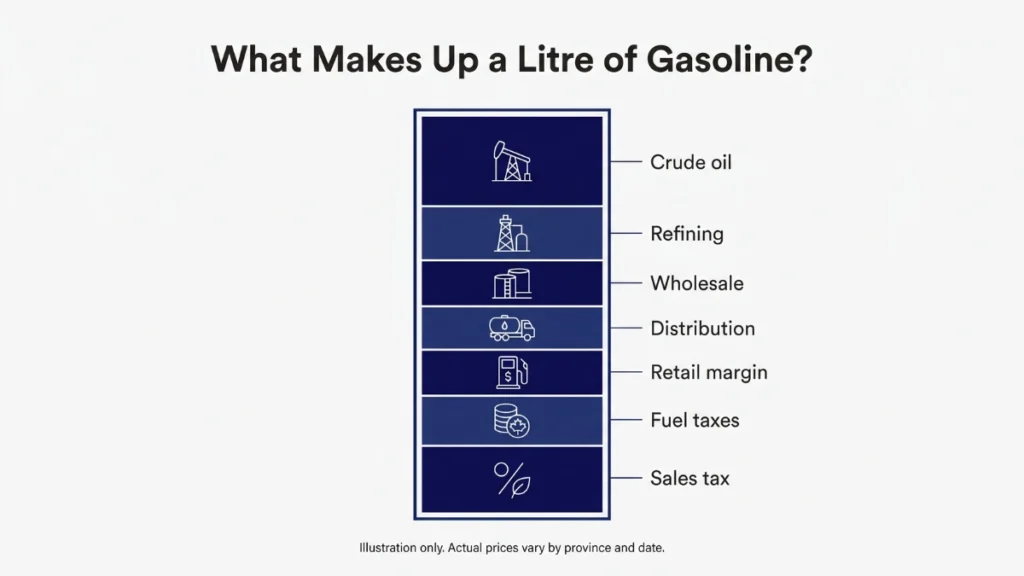
Crude oil is the largest piece. It is priced on global markets in U.S. dollars, so the exchange rate matters. In early 2026, West Texas Intermediate crude climbed sharply due to conflict in the Middle East, pushing well above $100 USD per barrel.
Refining and wholesale margins cover the cost of turning crude into usable gasoline and delivering it to a regional distribution point called the “rack.” In 2026, refining margins have stayed elevated because of strong global demand and limited refining capacity.
Distribution moves fuel from the rack to individual stations. Stations in remote areas or provinces far from refineries pay more.
The retail margin is what the local gas station keeps. It covers property taxes, insurance, electricity, wages, and credit card fees. This is typically the smallest slice, often between 7 and 12 cents per litre.
Taxes and charges make up the rest, and they come in multiple layers.
The Tax Layers at the Pump
Gasoline taxes in Canada stack in three tiers.
The federal tier includes the federal excise tax on gasoline (normally 10 cents per litre, temporarily suspended in 2026) and the 5% GST.
The provincial tier is where every province sets its own fuel tax, ranging from 6.2 to 19.2 cents per litre. Provinces also apply their own sales taxes, whether HST, PST, or QST.
The regional tier applies in certain cities, where local transit authorities add a per-litre fuel levy. Metro Vancouver, Victoria, and Montreal all apply these charges.
Some taxes are fixed amounts in cents per litre. Others are percentages. That distinction matters.
Federal Gas Taxes in 2026
Two major federal changes shape gasoline taxes in Canada in 2026.
The federal excise tax, normally 10.0 cents per litre, has been temporarily suspended from April 20 to September 7, 2026, setting it at zero. After that date, the standard rate is scheduled to return. This applies to gasoline, diesel, and aviation fuel.
The consumer carbon tax (the federal fuel charge) was fully removed on April 1, 2025. Before that, it added approximately 17.6 cents per litre.
However, the Clean Fuel Regulations remain in place. These are different from the old carbon tax. They require fuel producers to reduce the lifecycle carbon intensity of their fuels by investing in biofuel blending or purchasing compliance credits. Those costs are built into production and passed through to consumers. Some 2026 estimates place the Clean Fuel Regulations compliance cost at roughly 7 cents per litre, but this should be treated as an estimate, not a fixed tax charged at the pump. This is an estimate, not a fixed tax charged at the pump, and the actual cost may vary. Unlike the former carbon tax, there are no household rebates tied to it.
Provincial Fuel Taxes
Provincial fuel taxes are a major reason gas prices look different depending on where you live. The table below shows 2026 rates. These can change, so verify current rates with official provincial sources.
| Province / Territory | Fuel Tax (cents/litre) | Sales Tax | Notes |
|---|---|---|---|
| Alberta | 13.0 | 5% GST | Variable system tied to oil prices |
| British Columbia | 14.5 | 5% GST | Excludes Vancouver and Victoria transit taxes |
| Manitoba | 12.5 | 5% GST + 7% PST | Reduced from 14.0 |
| New Brunswick | 10.87 | 15% HST | Regulated market; Clean Fuel Adjuster may apply |
| Newfoundland and Labrador | 7.5 | 15% HST | Regulated market |
| Nova Scotia | 15.5 | 15% HST | Regulated market; Clean Fuel Adjuster may apply |
| Ontario | 9.0 | 13% HST | Reduced from 14.7 before 2022 |
| Prince Edward Island | 8.47 | 15% HST | Regulated market |
| Quebec | 19.2 | 5% GST + 9.975% QST | Highest provincial fuel tax; cap-and-trade adds embedded carbon cost |
| Saskatchewan | 15.0 | 5% GST | — |
| Yukon | 6.2 | 5% GST | Lowest fuel tax rate in Canada |
| Northwest Territories | 10.7 | 5% GST | — |
| Nunavut | 6.4 | 5% GST | — |
In the Atlantic provinces, regulated pricing and the “Clean Fuel Adjuster” add a specific charge to compensate refiners for federal clean fuel compliance costs.
Regional Taxes and Local Differences
Some of the sharpest price gaps come from regional fuel levies funding local transit.
In Metro Vancouver, the TransLink transit tax adds 18.5 cents per litre. Combined with other provincial levies, Vancouver drivers pay roughly 27 cents per litre in provincial and regional fuel taxes alone.
In Victoria, a transit tax of 5.5 cents per litre brings the total to about 20 cents per litre.
In Montreal, a 3-cent-per-litre ARTM tax pushes the combined regional total to around 22.2 cents per litre before sales taxes.
A driver can sometimes see a noticeable price difference simply by crossing a municipal boundary. The fuel is the same. The regional tax is not.
Fixed Costs vs. Variable Costs at the Pump
Fixed costs are set amounts in cents per litre that stay the same regardless of crude prices. Federal excise tax (when active), provincial fuel taxes, and regional levies are all fixed.
Variable costs are percentage-based. GST, HST, PST, and QST are calculated on the full subtotal, including fuel cost, margins, and fixed taxes combined.
This creates a “tax-on-tax” effect. When crude oil rises and pushes the base price higher, the dollar amount of sales tax rises too. A 13% HST on a $1.40 subtotal produces a different number than 13% on a $1.70 subtotal. The percentage stays the same, but the actual cents you pay go up.
Example Pump Price Breakdown
The table below is an illustration, not a universal price. It shows how components might stack for a litre of gasoline in Ontario in May 2026, assuming a pump price near $1.82. Actual prices vary by province, city, fuel grade, wholesale cost, and date.
| Component | Example Cost (cents/litre) | What It Means |
|---|---|---|
| Crude oil cost | 95.0 | Global market price, converted to Canadian dollars |
| Refining and wholesale margin | 42.0 | Processing and regional delivery |
| Retail margin | 8.0 | Local station operating costs and profit |
| Federal excise tax | 0.0 | Set to zero during the 2026 suspension |
| Provincial fuel tax (Ontario) | 9.0 | Fixed Ontario rate |
| Clean Fuel Regulations (est.) | 7.0 | Estimated compliance cost passed through by producers |
| HST (13%) | 21.0 | Percentage tax on the subtotal above |
| Total pump price | 182.0 |
When the excise tax holiday ends, 10.0 cents per litre returns to the stack, and the HST applies to that additional amount too, pushing the total higher by more than just 10 cents.
Why Do Gasoline Prices Differ Across Provinces?
Tax rates vary widely. Alberta charges 13.0 cents in fuel tax with 5% GST. Nova Scotia charges 15.5 cents with 15% HST. On a base fuel cost of $1.50, that sales tax difference alone adds roughly 15 cents per litre.
Distance from refineries matters. Canada’s refining capacity is concentrated in a few regions. Provinces without nearby refining or pipeline access face higher distribution costs.
Local competition and regulation differ. In unregulated markets like Ontario and Alberta, stations compete and prices can change multiple times daily. In regulated markets like PEI and Nova Scotia, a government board sets a maximum price weekly.
The Canadian dollar affects everything. Crude is traded in U.S. dollars. A weaker Canadian dollar means higher costs for refiners, passed along at the pump.
Why Tax Cuts Can Feel Smaller Than Expected
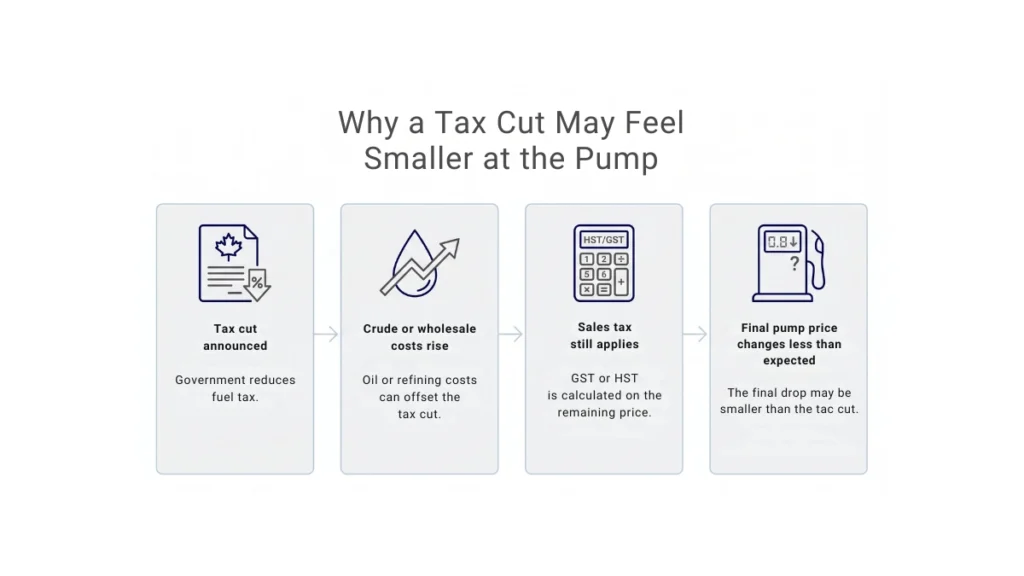
When a 10-cent tax cut is announced, many households expect exactly 10 cents to disappear from the pump price. It rarely works that cleanly.
Statistics Canada’s CPI reports regularly show gasoline as one of the more volatile household price categories, which is why tax changes can be hard to feel when market prices are moving at the same time. For example, a 10-cent tax cut can be offset by a 15-cent increase in crude oil costs.
Sales tax still applies as a percentage. Even after a fixed tax is removed, the GST or HST is calculated on the remaining subtotal. As that subtotal rises, the sales tax grows.
Retailers working through higher-cost inventory may not immediately lower prices. And at the household level, a few cents per litre translates to a modest dollar amount. On a 50-litre tank, a 4-cent effective savings is $2.00. Real, but not always easy to feel.
Household Impact

For a household filling a 60-litre tank once a week, a 10-cent temporary tax cut saves roughly $6.00 per fill-up, or about $24 to $30 a month during the suspension. That is not nothing. But if the base price has climbed 30 or 40 cents per litre over several years, the relief covers only part of the increase.
Fuel costs also ripple into the price of goods, since diesel prices affect trucking costs. That connection is real but indirect and slow-moving. For more on that relationship, see our article on why gas tax relief does not quickly lower grocery bills.
Key Facts
- Federal excise tax suspension: The federal excise tax on gasoline (normally 10.0 cents per litre) is temporarily suspended from April 20 to September 7, 2026, according to the Government of Canada.
- Consumer carbon tax removal: The consumer carbon tax was fully removed on April 1, 2025. The corresponding Canada Carbon Rebate payments ended with it.
- Clean Fuel Regulations estimate: Clean Fuel Regulations compliance costs are often estimated at roughly 7 cents per litre in 2026, but this is not a direct pump tax and the actual pass-through can vary. This is a compliance cost, not a direct tax, and may vary.
- Ontario fuel tax rate: Ontario’s provincial gasoline tax has been held at 9.0 cents per litre, reduced from 14.7 cents before 2022.
- Vancouver regional taxes: Vancouver drivers face approximately 27 cents per litre in combined provincial and regional fuel taxes, the highest in western Canada.
- Tax-on-tax effect: Sales tax (GST, HST, PST, or QST) is applied as a percentage on top of the fuel cost, margins, and fixed taxes, creating a compounding effect when base prices rise.
Closing
The pump price is not one number with one cause. It is a stack: crude oil, refining margins, a retail margin, fixed fuel taxes, percentage-based sales taxes, regional levies, and regulatory compliance costs that move at different speeds. Understanding the Canada gasoline price breakdown taxes 2026 structure will not make the price less frustrating, but it makes it less mysterious.
When you can see the layers clearly, you are in a better position to judge which headlines are telling you the full story. That kind of clarity is what Monetary Leaf is for.
Frequently Asked Questions
What taxes are included in gasoline prices in Canada?
Gasoline prices typically include a federal excise tax, a provincial fuel tax, and a sales tax (GST, HST, PST, or QST depending on the province). Some cities add regional fuel levies for transit. In 2026, the federal excise tax is temporarily suspended from April 20 to September 7.
How much of gas prices in Canada is tax?
It varies by province. In a province with moderate fuel taxes and 13% HST, taxes can account for roughly 15% to 25% of the pump price. In provinces with higher rates or cities with regional levies like Vancouver, the share is higher. The exact proportion depends on the base fuel price at any given time.
Why are gas prices different across Canadian provinces?
Provincial fuel tax rates range from 6.2 cents per litre in Yukon to 19.2 cents in Quebec. Sales tax systems differ. Some cities add transit levies. Distance from refineries affects distribution costs. And some provinces regulate retail prices while others let the market set them.
Is the carbon tax still charged on gasoline in Canada in 2026?
The direct consumer carbon tax was removed on April 1, 2025. The Clean Fuel Regulations remain, however. These require fuel producers to reduce carbon intensity, and the compliance costs are estimated to add roughly 7 cents per litre. There are no household rebates tied to this cost.
Why did the federal gas tax cut not lower prices by the full amount?
Global crude oil prices may rise at the same time. Retailers may be working through higher-cost inventory. Sales tax still applies as a percentage on the remaining subtotal. A 10-cent tax cut can be offset by a larger increase in crude costs.
What is the Clean Fuel Regulations cost?
The Clean Fuel Regulations require fuel producers to reduce the carbon intensity of their fuels. The Parliamentary Budget Officer estimated this adds roughly 7 cents per litre in 2026. This is an estimate and may change with credit market conditions.
Does a gas tax cut lower grocery prices?
Not directly or quickly. Fuel is one input in shipping costs, but grocery prices are shaped by many other factors. A temporary gas tax cut is unlikely to produce a visible drop in grocery prices on its own.
Disclaimer:
This article is for informational and educational purposes only and does not constitute financial, tax, legal, or investment advice. Fuel taxes, prices, and government rules can change. Please verify current rates with official federal, provincial, or local sources before making decisions.