Private Health Insurance Ontario: What Families Should Check Before Buying

Quick Answer: Is Private Health Insurance Ontario Worth It?
For Ontario families without workplace benefits, the decision on private health insurance comes down to what OHIP leaves out, what the Trillium Drug Program and Canada Dental Care Plan already cover, and whether the remaining gap justifies a monthly premium. Many families find that checking public programs first changes the math entirely.
For a full overview of how private health insurance works in Canada, including how premiums, limits, and deductibles work and what public programs to check, see our national guide to private health insurance in Canada for families without workplace benefits.
Maya spread the papers across her kitchen table in Scarborough after her 12-year-old finally fell asleep. She works part-time in retail during the week and picks up bookkeeping jobs on weekends. Her employer doesn’t offer extended benefits. Nobody she invoices on Saturdays does either.
On the table: a private health insurance quote from one insurer. A dental estimate for two fillings and a cleaning. A pharmacy receipt for her asthma inhaler, $147 this month. An email reminder about her daughter’s overdue eye exam.
The private health insurance quote said $138 a month. That was $1,656 a year. She stared at the number and tried to do the math against what she’d actually claim. And then she opened another tab on her laptop and typed the question most families in her position eventually ask: is private health insurance Ontario for families without workplace benefits actually worth the money, or is it just another bill?
What does OHIP not cover for Ontario families?
OHIP covers medically necessary physician and hospital services. But it was never designed to cover every health cost a family faces in a year. The Government of Ontario explains what O-H-I-P covers, and here is what falls outside OHIP for most working-age Ontario adults.
Prescription drugs dispensed at a retail pharmacy are not covered for adults aged 25 to 64. Children and youth under 25 without private insurance are covered through OHIP+, and seniors 65 and older are covered through the Ontario Drug Benefit program. But if you’re a working-age adult filling a prescription at your local pharmacy, that cost comes straight from your pocket.
Routine dental care, including cleanings, fillings, extractions, and orthodontics performed in a dental clinic, is not covered by OHIP. Eye exams for adults aged 20 to 64 are generally not covered unless you have a specific medical condition like glaucoma or diabetes-related eye disease. Glasses, contact lenses, and frames are entirely out of pocket.
Physiotherapy, chiropractic care, massage therapy, and mental health counselling outside of public hospital programs are also excluded. Even ambulance transport, while subsidized, usually carries a co-payment of $45 when deemed medically necessary, and can cost more if deemed unnecessary.
For a family without workplace benefits, these gaps add up quickly over a year.
Most Ontario families without workplace benefits are in that position because part-time, contract, and self-employed workers rarely receive employer health coverage. For the national data on who has access to workplace benefits and who doesn’t, see our guide to private health insurance in Canada for families without workplace benefits.
Private health insurance in Ontario wraps around OHIP to cover prescriptions, dental, vision, paramedical services, and more, but every plan applies its own limits, co-payments, and exclusions. For a full breakdown of how private health insurance works in Canada, including what ‘covered’ actually means, see our national guide.
How Much Does Private Health Insurance Cost in Ontario?
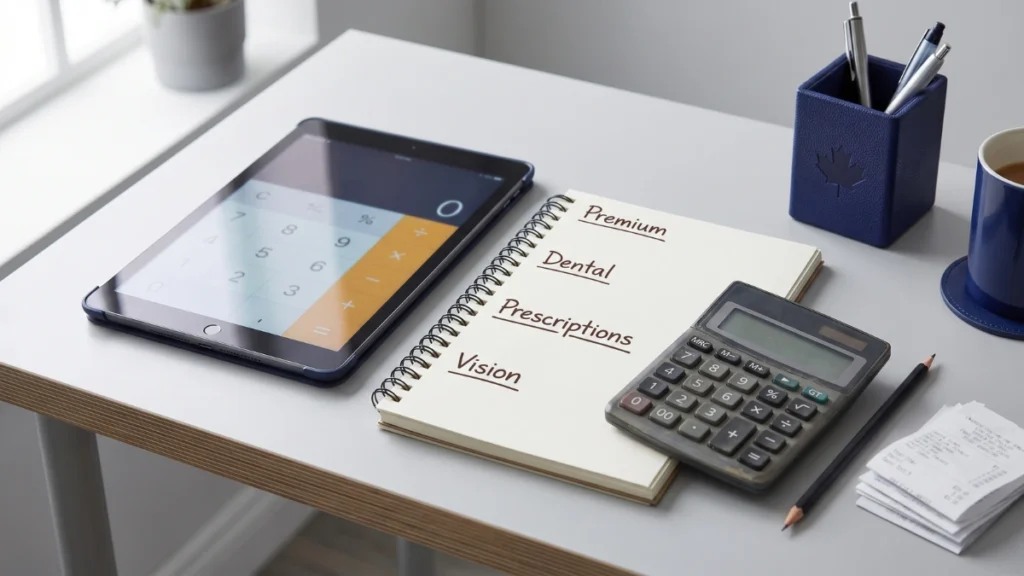
Reliable average premium data for individual private health insurance plans in Ontario is difficult to pin down, because final pricing depends heavily on age, family size, health history, location, and the specific plan tier selected.
Sample quotes and insurer plan examples show wide variation. Basic single-person plans for a healthy adult aged 25 to 35 may start in the range of $58 to $61 per month. Standard couple coverage may range from roughly $110 to $200 per month. Comprehensive family coverage for two adults and two children can run from approximately $277 to well over $800 per month, depending on the plan and insurer.
These are sample ranges, not guaranteed prices. Guaranteed-issue plans, which accept applicants without medical questions, tend to carry higher premiums and lower coverage limits. Final quotes will vary, and families should request current quotes based on their own household details.
These sample ranges were gathered in 2025 and 2026.
The real question isn’t just what the premium costs each month. It’s what the premium costs compared to how much the plan will actually pay back in a typical year, after accounting for limits, exclusions, and co-payments.
How Does The Trillium Drug Program Reduce Prescription Costs in Ontario?
Before committing to a private drug plan, Ontario families should check the Trillium Drug Program (TDP). This provincial program is designed for Ontario residents whose annual out-of-pocket prescription costs are high relative to their household income.
The TDP is income-tested. According to the Government of Ontario, the annual deductible is generally calculated at approximately 4% of after-tax household income. That deductible is split into four quarterly payments across the program year (August to July). Once a family meets their quarterly deductible through pharmacy spending on eligible drugs, the program covers the remaining costs for eligible prescriptions that quarter, with the family paying only a nominal co-payment of up to $2 per prescription.
For a family earning $60,000 after tax, that means an annual deductible of roughly $2,400, or $600 per quarter. If a family member takes a costly chronic medication, the TDP can significantly reduce the total out-of-pocket burden.
Not every family will qualify, and not every drug is covered. But checking Trillium before buying private drug insurance can prevent paying premiums for protection a public program already provides.
Does Buying Private Dental Insurance In Ontario affect CDCP Eligibility?
Routine dental care is one of the biggest out-of-pocket costs for Ontario families, and it’s completely excluded from OHIP. Private dental insurance Ontario may help, but most plans cap annual dental benefits at modest amounts, require co-payments of 20% to 30%, impose waiting periods for major work like crowns or root canals, and may not cover orthodontics at all under standard tiers.
Before buying private dental coverage, families should check the Canada Dental Care Plan (CDCP). The Canada Dental Care Plan (CDCP) provides dental coverage for families with adjusted net income under $90,000 who have no access to private dental insurance.
Families with adjusted family net income under $70,000 may qualify for coverage with no co-payments at the CDCP fee rate, though dentist charges and covered services still matter. Those between $70,000 and $89,999 face income-scaled co-payments of 40% or 60%.
In Ontario, one additional detail matters: dentists often charge based on the Ontario Dental Association fee guide, which can be higher than the CDCP reimbursement rate. This means ‘no co-payment’ under CDCP does not always mean zero out-of-pocket cost at an Ontario dental office.
The critical point for families weighing private coverage is this: having access to private dental insurance, even if you pay for it yourself, can affect your CDCP eligibility. Families should check CDCP rules carefully before purchasing any plan that includes dental benefits.
How much do private plans cover for vision, therapy, and paramedical care?
Adult eye exams, glasses, physiotherapy, massage therapy, chiropractic care, mental health counselling, and ambulance co-payments all sit outside OHIP for most working-age adults. Private plans may cover these, but standard plans often cap eyewear at $200 every two years, paramedical services at $300 to $500 combined, and mental health therapy at limited per-visit amounts. Before buying coverage primarily for these services, add up your actual annual spending in each category and compare it to what the plan would realistically reimburse.
Fine Print Ontario Families Should Check
Private health insurance plans come with annual limits, co-payments, deductibles, waiting periods, and exclusions that reduce the real value of coverage. For a detailed breakdown of what to check, see our national guide. Ontario families should pay particular attention to these additional details:
Prescription formularies
Not every medication is covered. Plans maintain formularies, and a drug your doctor prescribes may not be on the list.
Children aging out
Dependent children typically age out of family coverage at 21, or at 25 if enrolled full-time in post-secondary education. Families should check exact rules in any policy.
Premium increases
Retail premiums are not locked in. They can increase with age-band changes, annual renewals, or adjustments by the insurer.
Private Insurance vs. Self-Funding
| Ontario Family Situation | Private Insurance May Help When | Public Programs May Work When |
|---|---|---|
| High Prescription Costs | Medication costs are steady but fall below the high deductible required by provincial safety nets. | The household qualifies for the Trillium Drug Program because annual drug costs represent a severe percentage of net income. |
| Children’s Dental Needs | Adjusted family net income is above $90,000, meaning the household does not qualify for the federal CDCP. | Adjusted family income is under $90,000, allowing the family to utilize the CDCP for routine dental needs. |
| Therapy, Physio, or Paramedical Care | A family member requires regular chiropractic, massage, or physiotherapy sessions, which are generally excluded from standard OHIP coverage. | Needs are highly irregular or short-term, meaning paying out of pocket is cheaper than paying fixed monthly premiums. |
| Existing Public Program Access (CDCP or Trillium) | Private coverage is used intentionally to fill the precise gaps or co-payments that public assistance leaves behind. | Public programs (like Trillium or CDCP) already cover the family’s largest, most devastating health exposures. |
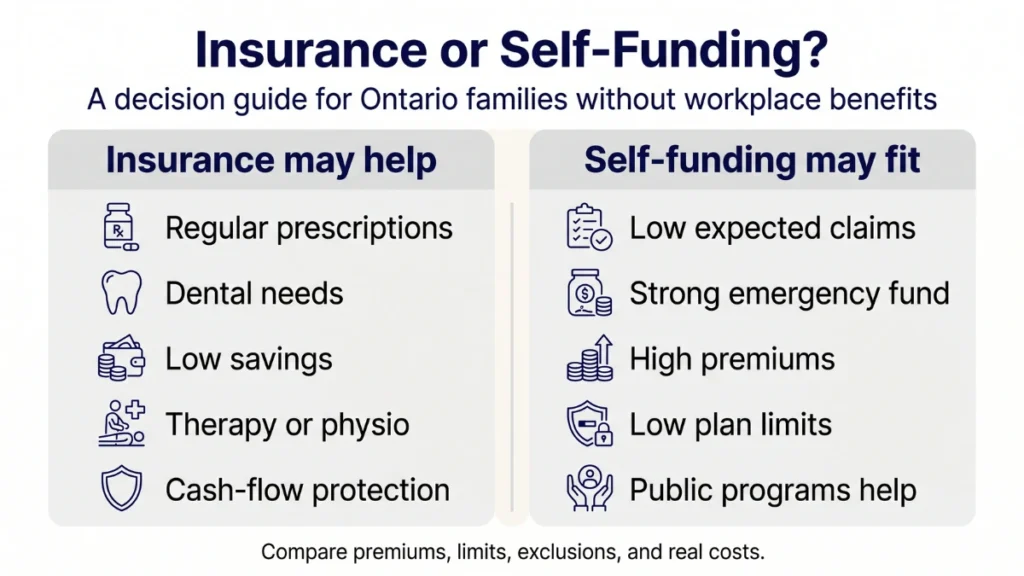
Private Insurance vs Self-Funding Checker
Private Insurance vs Self-Funding Checker
Use this quick checker to compare yearly private insurance premiums with the health costs your family may realistically claim.
This isn’t about taking risks with your family’s health. It’s about matching the right tool to your household’s real costs, public program eligibility, and monthly cash flow. For the broader national version of this decision, read our guide to private health insurance in Canada for families without workplace benefits.
Check Public Programs First
Before paying for private health insurance, Ontario families should check: the Trillium Drug Program for prescriptions, OHIP+ for children’s prescriptions (under 25), the Ontario Drug Benefit for seniors (65+), the Canada Dental Care Plan for dental, the CRA Medical Expense Tax Credit for tax relief on out-of-pocket costs, and any workplace benefits a spouse may have access to. For the full list of public programs to check, see our national guide.
Do newcomers to Ontario get OHIP coverage right away?
Ontario permanently eliminated the historical three-month OHIP waiting period in 2020. Eligible residents now receive active provincial health coverage once their application is approved at ServiceOntario. But newcomers must still meet O-H-I-P eligibility, residency and immigration status requirements, including being physically present in Ontario for at least 153 days in any 12-month period and holding an eligible status such as Canadian citizenship, permanent residency, or a qualifying work permit.
For families arriving in Canada, basic banking setup is another early first-month decision that can affect cash flow.
International students, visitors, and some temporary residents may not qualify for OHIP and should consider private emergency medical coverage. This is a different need from the family private health insurance discussed in this article, and it’s worth understanding the distinction before purchasing.
Key Facts: Private Health Insurance Ontario
- OHIP covers many medically necessary physician and hospital services, but it does not cover routine dental, adult vision, most prescriptions for ages 25 to 64, or paramedical therapies like physiotherapy and massage.
- The Trillium Drug Program helps Ontario households whose annual prescription costs are high relative to income, with deductibles calculated at approximately 4% of after-tax household income.
- Canada Dental Care Plan eligibility requires no access to private dental insurance and a household income under $90,000.
- Ontario permanently removed the historical three-month OHIP waiting period for eligible residents in 2020.
A Checklist Before Buying
For the full pre-purchase checklist covering limits, deductibles, waiting periods, and co-payments, see our national guide. Ontario families should also check these specifically:
- Check whether your medications are on the Ontario Ministry Health Formulary, as not every drug is covered.
- Review the Trillium Drug Program eligibility guidelines for your household.
- Confirm OHIP+ program terms for children under 25
and check the Ontario Drug Benefit rules for seniors 65+ before buying redundant premium structures. - Verify the official federal CDCP criteria to see how purchasing a private plan impact your access to public dental coverage.
- Check the CRA guidelines on PHSP premiums to optimize your deductions if you run a small business or are self-employed.
For freelancers, contractors, and sole proprietors, the decision can be different, so read our guide to personal health insurance Canada for self-employed workers.
Closing: Buy Only What Makes Sense
Maya didn’t make her decision that night. She closed the laptop, put the papers in a folder, and went to bed knowing she had a clearer picture than she started with.
The right choice depends on what OHIP leaves out, what Trillium and CDCP already cover, and what the remaining gap actually costs your family in a typical year.
Frequently Asked Questions
What does OHIP not cover for Ontario families?
OHIP does not cover retail prescription drugs for adults aged 25 to 64, routine dental services, adult eye exams for those aged 20 to 64 (with some medical exceptions), corrective eyewear, paramedical therapies, mental health counselling outside public programs, standard ambulance co-payments ($45), or semi-private and private hospital room upgrades.
How much does private health insurance cost in Ontario?
Costs vary widely. Sample quotes show basic single plans starting around $58 to $61 per month, couple coverage ranging from roughly $110 to $200 per month, and family plans ranging from approximately $277 to over $800 per month depending on coverage tier, age, family size, and health history. These are sample ranges, not guaranteed rates.
Does private health insurance Ontario cover dental and prescriptions?
Most comprehensive private health plans include dental and prescription drug coverage, but both are subject to annual caps, co-insurance (typically 70% to 80% reimbursement), and possible exclusions for pre-existing conditions. Dental coverage for major work often has long waiting periods.
Should Ontario families check the Trillium Drug Program before buying private insurance?
Yes. The Trillium Drug Program can significantly reduce prescription costs for Ontario families whose annual drug expenses are high relative to household income. Checking TDP eligibility before buying a private drug plan can prevent paying premiums for coverage a public program already provides.
Can private dental insurance affect Canada Dental Care Plan (CDCP) eligibility?
Yes. To qualify for the CDCP, applicants must not have access to any form of private dental insurance. Purchasing a private plan that includes dental benefits, even one you pay for yourself, can affect CDCP eligibility. Families should check CDCP rules before buying any coverage that includes dental.
Can self-employed people in Ontario buy private health insurance?
Yes. Self-employed individuals can purchase private health insurance plans in Ontario. If they operate a sole proprietorship or incorporated business, their premiums may be deductible as a business expense under CRA rules if the plan qualifies as a Private Health Services Plan. Specific conditions and annual limits apply, and checking with the CRA or a tax professional is recommended.
Should newcomers to Ontario buy private health insurance before OHIP starts?
Ontario eliminated the historical three-month OHIP waiting period in 2020. Eligible residents receive coverage once their application is approved. However, newcomers must still meet residency and status requirements, and those who don’t qualify for OHIP, such as international students or visitors, should consider private emergency medical coverage to protect against hospital and medical costs.
Disclaimer:
This article is for informational and educational purposes only and does not constitute financial, legal, tax, or investment advice. Individual circumstances vary, so please use your own judgment and consult a qualified professional when appropriate.