Why Are Groceries So Expensive in Canada? The $17,500 Squeeze
Quick Answer: Why Are Groceries So Expensive in Canada?
- Grocery prices are roughly 30% higher than in 2021, and they are not coming back down. This is a permanent price-level reset, not a temporary spike.
- Food purchased from stores rose 4.3% year over year in May 2026, the 16th straight month food inflation has outpaced the overall rate (Statistics Canada, June 22, 2026).
- Fresh vegetables jumped 9.0% year over year in May, the largest May increase since 2008. Tomato prices alone surged 45.2%, driven by supply contractions in Mexico.
- The causes are structural: five chains control about 80% of grocery sales, plus supply chain costs, internal trade barriers, and past tariff disputes.
- A family of four is projected to spend up to $17,571 on food in 2026, about $1,000 more than the year before (Canada’s Food Price Report 2026).
- This is not a personal budgeting failure. Food prices rose around 30% in four years while wages did not keep pace.
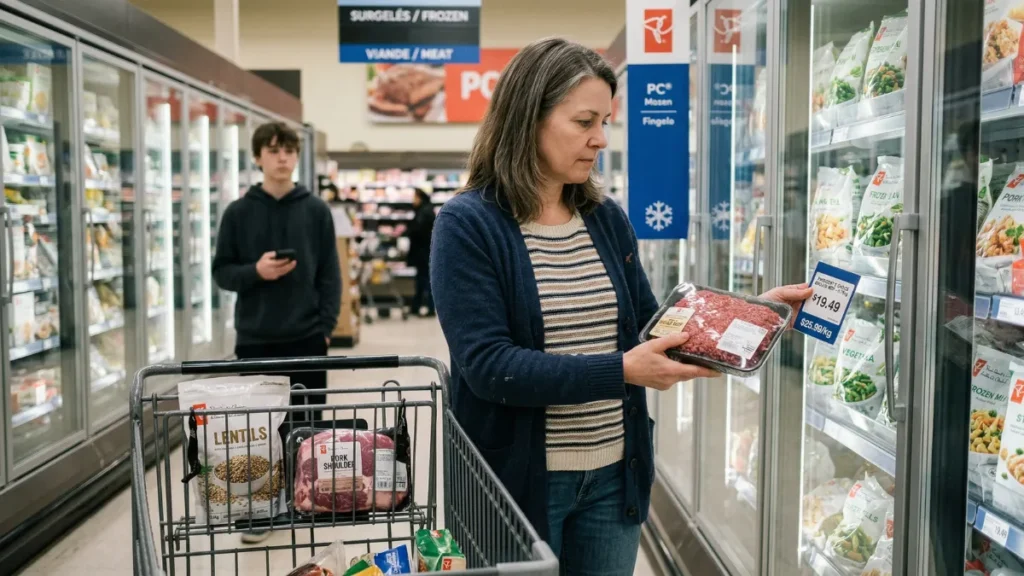
Sandra noticed it first in the frozen foods aisle.
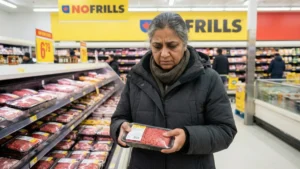
She’d reached for the ground beef without looking at the price, the way she had done for years, the way you do when a thing has always cost roughly the same. Then she saw the tag. Nineteen dollars and change for a kilogram. She put it back. Not dramatically, not with a scene. She just put it back and stood there a moment, then moved on to the chicken. That was fourteen dollars. She put that back too.
She ended up with a bag of lentils and a pack of pork shoulder that was on sale, and she felt quietly ridiculous about it. Not because lentils are bad. They’re not. But because she hadn’t planned on lentils. She’d planned on a regular Tuesday dinner, the kind that doesn’t require a decision.
That’s what grocery shopping does to you now. It turns ordinary moments into small negotiations with yourself.
Sandra is in her mid-forties, works full-time in Mississauga, and shares a home with her husband and their teenage son. They’re not struggling in the way that people mean when they use the word struggling. They have jobs. They have a mortgage. They have internet and a car. But their grocery bill has climbed over the last four years in a way that doesn’t match anything in their budget, and the gap between what they expected to spend and what they actually spend has become a steady, quiet drain on everything else. It is a classic example of responsible people feeling financial pressure in their 50s in Canada as they navigate their peak earning years in an unstable economy.
Why Are Groceries So Expensive in Canada Even as Inflation Shifts
She’s not alone in this. Not even close.
The headline inflation number keeps shifting. It cooled to 1.8% early in 2026, then climbed back to 3.2% by May, pushed up mostly by gasoline. But here is the part that matters for your receipt: food purchased from stores rose 4.3% year over year in May 2026, and it has now outpaced the overall inflation rate for 16 months in a row, according to Statistics Canada. That gap is the thing most households are actually living inside. It leads to the frustrating question many are asking: with inflation down, why is everything so expensive in Canada? The soothing number is the average. The painful number is the grocery receipt.
Why Grocery Prices Still Feel So High
Even though headline inflation has cooled, food prices are still rising faster than the overall rate, and grocery costs remain far above where they were a few years ago.
- Headline CPI, May 2026: 3.2%
- Food purchased from stores, May 2026: 4.3% (16th straight month above the headline)
- Basic grocery basket increase since 2021: roughly 30%
- Forecast food price increase for 2026: 4% to 6%
This is the confusion that sits underneath every shopping trip right now. The economy is apparently calming down, and yet nothing at the till feels calm. People feel gaslit by this, though they’d rarely use that word. They just know that the reassurances don’t match the experience, and after a few years of that, they’ve mostly stopped expecting them to.
The 30% Reset: What Grocery Prices Actually Did
Here’s what’s actually happening.
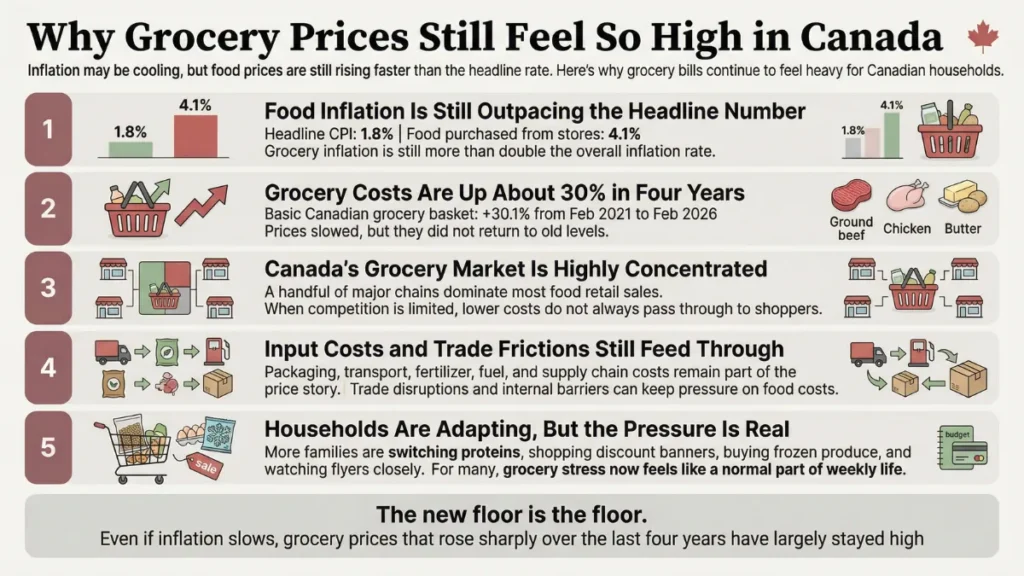
Between February 2021 and February 2026, the cost of the basic Canadian grocery basket rose by 30.1%. That’s cumulative. That’s the whole stack. So when analysts say inflation is slowing, they mean the rate of increase has softened. They don’t mean prices came back down. A kilogram of ground beef that cost you nine or ten dollars in 2020 now regularly costs over fifteen. Chicken breasts hover around fourteen dollars a kilogram. Butter is nearly six dollars for a small block. Potatoes, which are supposed to be the reliable, unglamorous staple, are five dollars a kilogram. [Related: Ground beef price per kg Canada 2026]
These aren’t temporary spikes. This is the new floor.
How the Grocery Math Changed
| Grocery Measure | Earlier Reference Point | 2026 Example |
|---|---|---|
| Headline inflation (CPI) | General inflation benchmark | 3.2% (May 2026) |
| Food purchased from stores | Above the headline for 16 months straight | 4.3% (May 2026) |
| Basic grocery basket | 2021 baseline | roughly +30% by 2026 |
| Ground beef | About $9 to $10/kg in earlier years | Over $15/kg |
| Chicken | Lower pre-spike levels | Around $14/kg |
| Butter | Lower pre-spike levels | Nearly $6 |
| Potatoes | Traditional low-cost staple | Around $5/kg |
There was a brief, strange moment at the start of 2025 when food inflation actually dipped to negative territory for the first time in about a decade. That happened because the federal government temporarily removed the GST and HST on essential foods and beverages, running from mid-December 2024 through mid-February 2025. Prices seemed to fall. People noticed. But when the tax relief ended and prices returned to their normal trajectory, the year-over-year comparisons in early 2026 looked especially steep.
Restaurant prices, which had benefited most from the tax holiday, showed a staggering 12.3% jump in January 2026 compared to the same month the year before. The dip wasn’t a recovery. It was a pause, followed by a sharper rebound, and now those numbers are feeding the 2026 data in ways that make food inflation look worse than it might otherwise.
Why The System Doesn’t Let Prices Fall
The structural problem predates all of that.
Canada’s grocery market is dominated by five major players: Loblaw, Sobeys, Metro, Walmart, and Costco. Together, they control roughly 80% of the retail food market. The Competition Bureau has flagged this concentration as a direct barrier to affordability. When input costs fall, these retailers don’t have to pass the savings along. Competition isn’t forcing their hand.
There’s also the matter of internal trade. Canada has long had a patchwork of provincial regulations around food labeling, packaging, and safety that make it difficult for a producer in one province to easily sell in another. That adds invisible costs. The “One Canadian Economy Act,“ which received Royal Assent in mid-2025, is trying to address this, and Ontario and Alberta have made some early moves. But supply-managed commodities like dairy and poultry remain protected by their own structures, and change in those sectors is slow by design.
Then there’s the 2025 trade dispute with the United States. The 25% tariffs imposed on Canadian goods, and Canada’s retaliatory measures, drove up input costs across the supply chain. Nitrogen fertilizer prices in parts of Western Canada rose 30 to 40% during the peak of the trade war. Farmers who bought that expensive inventory are now working their way through it, and those costs are showing up in the 2026 grocery aisle as higher prices for grain-based products and vegetables. A February 2026 Supreme Court ruling struck down many of the tariffs as unconstitutional, but the supply chain doesn’t correct itself overnight.
For a closer look at milk, butter, cheese, and yogurt, see our guide to dairy prices in Canada 2026.
How Families Are Adjusting To The New Grocery Reality
So how are people actually managing?
The straightforward answer is: with great effort and diminishing dignity. A 2026 survey from debt-relief firm Spergel found that 53.2% of Canadians used a credit card, a Buy Now Pay Later service, or a payday loan to purchase groceries in the last six months of 2025 and into 2026. Roughly 40% delayed paying a utility bill to make sure they could afford their weekly shop. More than 60% reported skipping meals or reducing portions.
These aren’t crisis statistics from a recession. They’re the baseline of ordinary life in 2026.
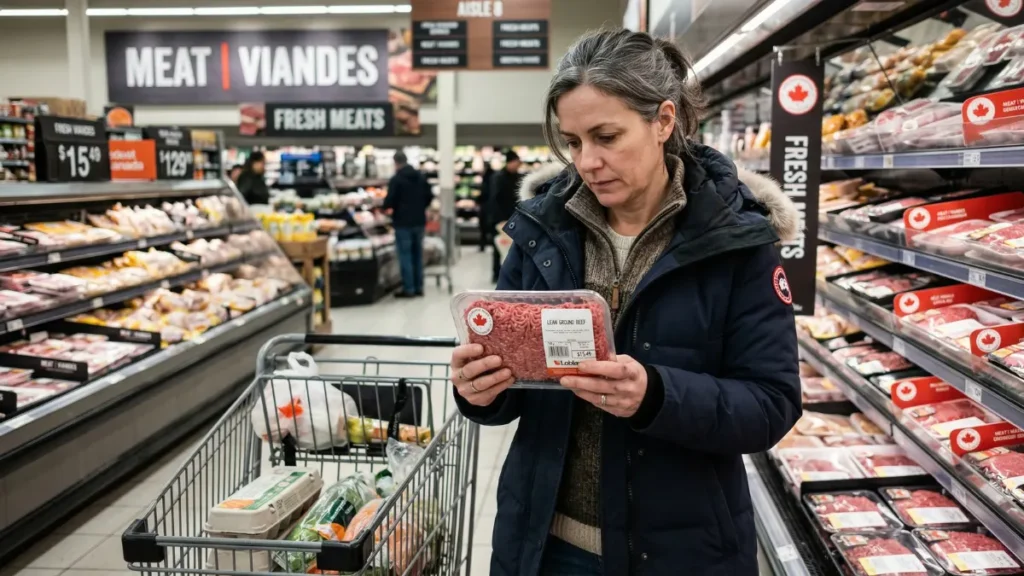
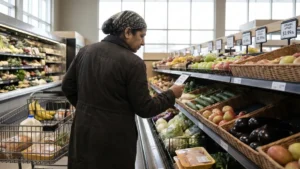
If you’re in Sandra’s position, some of what’s working is unglamorous but real. Protein substitution is the biggest lever. When you track the shifting protein prices in Canada 2026, it becomes clear that pork shoulder, whole chicken thighs, canned legumes, and eggs are all significantly cheaper than the cuts people gravitate toward by habit. Whole chickens cost less per kilogram than pre-cut breasts and stretch across more meals. Lentils and dried beans, once staples in many immigrant kitchens that mainstream shoppers largely ignored, are now getting a second look from households who hadn’t thought about them before.
Store-switching takes more time but it works. Discount banners like FreshCo, No Frills, and Food Basics carry the same private-label products for meaningfully lower prices than their parent chains. Price-matching, which most major Canadian grocers offer, is underused because it requires attention. One grocery-focused app or flyer habit per week is often enough to make the difference on the highest-ticket items.
Buying in larger quantities when things are genuinely on sale, especially non-perishables, is worth doing when cash flow allows. The warehouse club model makes more sense now than it did when prices were lower and the delta between formats was smaller.
Some people are growing small amounts of food, mostly herbs and tomatoes, because even that little bit of control feels good when the grocery aisle doesn’t.
Frozen fruit and vegetables, long dismissed as inferior, are nutritionally comparable to fresh and considerably cheaper. Fresh fruit provided a brief bright spot early in 2026, with prices dipping about 3.1% year over year in January. That did not hold. By May, fresh fruit prices had turned back up, rising 5.3% year over year, led by berries and grapes (Statistics Canada, May 2026).
Chicken prices are expected to rise through the rest of the year as consumers move away from expensive beef and drive up poultry demand. Meat as a category is forecast to rise 5 to 7% over the course of 2026. Bakery and dairy will see more modest increases in the 2 to 4% range.
The federal government has a new tool called the Canada Groceries and Essentials Benefit, which is essentially a rebranded and expanded version of the GST credit. A one-time top-up is expected by spring or no later than June 2026, and a 25% increase to the base quarterly payment begins in July, indexed to inflation for five years. For a couple with two children earning around $40,000 net, the maximum combined value in 2026 to 2027 reaches $1,890. For a single individual, the maximum is around $950.
These payments matter for the households they reach. But there’s a gap that’s hard to ignore. A household earning $70,000 or $90,000 or $105,000 doesn’t qualify for much, sometimes anything, and those are households that are also finding themselves in the credit orbit. They earn enough that the government doesn’t classify them as needing help. They spend enough on shelter, childcare, and debt servicing that groceries have become genuinely difficult. There’s no clean policy response for that yet.
The Quiet Weight of Watching Every Item
The emotional weight of all this is harder to measure but easier to feel.
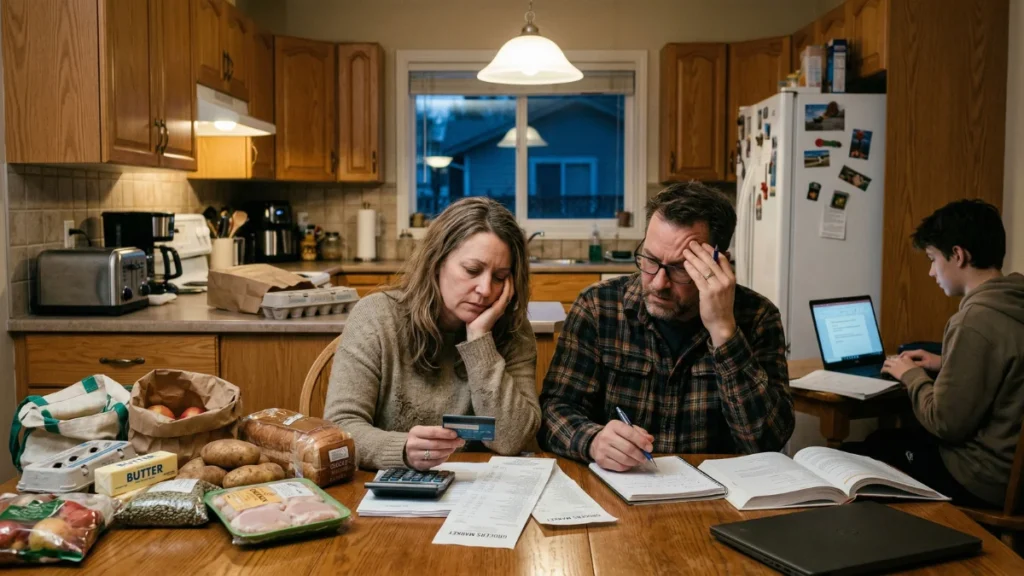
There’s a particular kind of exhaustion that comes from years of managing a problem that hasn’t resolved. Not crisis exhaustion, which at least has a name and a shape, but the low-grade, weekly kind that arrives every time you push a cart down an aisle and do mental arithmetic you never expected to need. People who were never anxious about food are anxious about food. Parents who thought they’d given themselves enough of a buffer are discovering the buffer is gone. Professionals earning decent salaries are putting chicken on a credit card and feeling quietly ashamed about it.
The shame is worth naming because it does real damage. It makes people less likely to talk about what they’re going through. It makes them maintain appearances at the checkout while the debt quietly compounds. It creates a kind of social loneliness around money that is, at this point, entirely unnecessary. Almost everyone is feeling something like this. The scale of it is large enough that personal failure can’t be the explanation.
The price of food rose by 30% in four years. Wages didn’t. That’s not a reflection of anyone’s judgment or effort. It’s arithmetic.
What To Expect for The Rest of 2026
Looking ahead, the consensus among economists is steady but not encouraging. Canada’s Food Price Report 2026, produced annually by researchers at Dalhousie, Guelph, UBC, and other institutions, forecasts an overall food price increase of 4 to 6% for the year. The average family of four is projected to spend up to $17,571 on food in 2026, roughly $1,000 more than the year before. Regional variations exist. British Columbia, Manitoba, and Saskatchewan are forecast to see more moderate increases. Alberta, Ontario, Quebec, and the Atlantic provinces are expected to see above-average pressure.
The Grocery Code of Conduct became fully operational on January 1, 2026, with all major retailers signed on. It establishes clearer trade rules between grocers and suppliers and creates a governance structure to manage disputes. Experts like Dr. Sylvain Charlebois have been measured in their optimism. The code, in its current form, is aimed more at stabilising the system than reducing prices. The target, if things go well, is a food inflation rate below 2.5%. That’s not falling prices. That’s slower growth.
The era of cheap food, if it was ever really that, is over. That’s the consensus. The question now is whether the structural reforms, the trade adjustments, and the policy support add up to something that softens the landing.
Key Facts
Canadian Grocery Pressure | By the Numbers
- Food purchased from stores rose 4.3% year over year in May 2026, the 16th consecutive month food inflation has outpaced the headline rate. (Statistics Canada, Consumer Price Index, May 2026)
- Five grocery retailers; Loblaw, Sobeys, Metro, Walmart, and Costco; control approximately 80% of Canada’s retail grocery sales, a concentration level the Competition Bureau has flagged as a barrier to affordability. (Competition Bureau of Canada, Retail Grocery Market Study, 2023)
- The Canada Groceries and Essentials Benefit, which replaces the GST/HST credit starting July 2026, provides up to $1,890 for a family of four and up to $950 for a single individual in the 2026–27 benefit year, including the one-time top-up. (Canada Revenue Agency / Department of Finance Canada)
- The Canada Grocery Code of Conduct became fully operational on January 1, 2026, with all five major national retailers formally registered. (Office of the Grocery Sector Code of Conduct)
- Since 2020, food prices have risen faster than overall inflation, costing the average Canadian household an estimated $782 more than general inflation alone would account for. (Department of Finance Canada)
You’re Not Failing. The Math Has Changed
What’s already true is this: the financial reality of grocery shopping in Canada has genuinely changed. The 30% increase didn’t un-happen. The new floor is the floor. What used to feel like a normal weekly errand now requires a kind of steady, low-level vigilance that costs people real mental energy. That’s an honest cost. It’s not something a slightly better shopping strategy fully solves.
If you’re finding yourself putting things back, switching stores, eating differently, carrying low-level stress into a space that used to feel routine, you’re not managing badly. You’re responding rationally to a price environment that shifted faster than anything around it. The math is hard. You haven’t lost your ability to do it. The numbers just got harder.
That’s what’s worth holding onto when the checkout total lands. If you are looking for a way to rebuild the buffer that the last four years have eroded, you might need a more comprehensive Canadian roadmap to recover financially and protect your future.
That’s what’s worth holding onto when the checkout total lands.
Frequently Asked Questions
If inflation is down, why are grocery prices still so high?
Inflation measures the rate of price increases. When it slows, prices are still rising, just less quickly. What households feel is the cumulative effect: grocery prices are 30% higher than they were in 2021, and that new baseline has not come back down.
Is the cost of meat and fresh produce ever going to return to normal?
“Normal” has changed. Beef prices rose nearly 14% year over year as of early 2026, and experts expect meat to rise another 5 to 7% across 2026. Fresh produce prices fluctuate seasonally, but the overall floor for food has permanently moved higher.
What’s really behind the higher grocery bills; is it just inflation?
No. Canada’s highly concentrated grocery market, supply chain disruptions, internal trade barriers, and past tariff disputes all play a role. These structural factors mean that even when input costs fall, retail prices often stay high.
What can I actually do to make groceries more affordable right now?
Small shifts add up: swapping some fresh meat for legumes or frozen alternatives, price‑matching at stores that offer it, and using discount banners like FreshCo or No Frills. Buying in bulk when staples are on sale and leaning on frozen fruits and vegetables can also help.
Disclaimer:
This article is for informational and educational purposes only and does not constitute financial, legal, tax, or investment advice. Individual circumstances vary, so please use your own judgment and consult a qualified professional when appropriate.