
Dairy Prices in Canada 2026: Milk, Butter & Cheese Costs
Quick Answer: What does dairy cost in Canada right now?
As of early 2026, the national average price for a 4L bag of 2% milk sits at $7.07 (roughly $1.77 per litre). According to official Statistics Canada food price tracking, a standard 454g block of store-brand butter averages $5.50 after recovering from its 2023 peak, while block cheese hovers around $14.00 per kilogram. Prices remain structurally higher in Canada than in open-market countries like the United States due to the federal supply management system. To keep costs down, shoppers should focus on discount banners, store brands, and larger item sizes, which offer cost reductions of up to 38% per unit.
Want to compare your own store prices? Jump to the Dairy Aisle Savings Calculator Canada
🎧 Pressed for time? This summary covers what does dairy cost in Canada right now?
You’re standing in the dairy aisle doing math you didn’t used to do. A 4L bag of milk, a block of butter, a brick of cheddar, a tub of yogurt. You haven’t bought anything fancy. You haven’t reached for a single name brand. And you’re already past thirty dollars. If you’ve noticed dairy prices in Canada 2026 climbing steadily over the past few years, you’re not imagining it. Here’s what the numbers actually say.
What Are Canadians Actually Paying for Dairy Right Now?
National averages tell part of the story, but what you actually pay depends heavily on where you shop. The table below compares shelf prices for four everyday dairy items across major Canadian grocery chains.
Prices observed May 2026. Sale prices noted where applicable.
| Product | Walmart | No Frills | Loblaws | Metro | Sobeys |
|---|---|---|---|---|---|
| Milk, 2%, 4L | $7.18 (Natrel) | $4.98 (Beatrice, sale) | $5.99 (Neilson, sale) | $5.98 (Natrel, sale) | $4.98 (Beatrice, sale) |
| Butter, salted, 454g (store brand) | $4.97 (Great Value, rollback) | — | $6.19 (No Name) | $5.99 (Selection) | $5.00 (Compliments, sale) |
| Cheddar cheese, 400g block (store brand) | $5.48 (Great Value) | $5.99 (No Name) | $5.99 (No Name) | $3.99 (Selection, sale) | — |
| Yogurt, 650–750g tub | $4.27 (Olympic, rollback) | $5.79 (No Name 12-pack) | $3.30 (Balkan, 750g) | — | — |
On any given week, flyer sales at discount banners can run $2.00 or more below conventional shelf prices on the same 4L milk price Canada shoppers see at full-price stores.
According to Statistics Canada’s scanner data for March 2026, here’s what the cost of milk Canada-wide looks like at the national average level:
| Product | Size | National Average (March 2026) |
|---|---|---|
| Milk | 4 litres | $7.00 |
| Milk | 2 litres | $5.51 |
| Butter | 454 grams | $5.50 |
| Block cheese | 500 grams | $7.00 |
| Yogurt | 500 grams | $3.80 |
This is why grocery inflation in Canada feels like a full-basket problem, not just a dairy problem.
How Much Have Dairy Prices Gone Up Since 2021?
The cumulative picture over five years is where the pressure becomes clear. Here’s how the average price of milk, butter, and cheese has moved since 2021.
| Year | Milk (per litre) | YoY Change | Butter (454g) | YoY Change | Cheddar (per kg) | YoY Change |
|---|---|---|---|---|---|---|
| 2021 | $1.38 | — | $5.50 | — | $13.00 | — |
| 2022 | $1.48 | +7.2% | $5.80 | +5.5% | $13.50 | +3.8% |
| 2023 | $1.62 | +9.5% | $6.35 | +9.5% | $13.62 | +0.9% |
| 2024 | $1.68 | +3.7% | $6.23 | −1.9% | $13.56 | −0.4% |
| 2025 | $1.71 | +1.8% | $5.62 | −9.8% | $13.72 | +1.2% |
| 2026 | $1.75 | +2.3% | $5.50 | −2.1% | $14.00 | +2.0% |
The milk price increase Canada has experienced since 2021 is roughly 27% cumulative. The sharpest jump was 2023, when per-litre prices surged 9.5%. The rate has cooled since, but prices haven’t reversed. That same pattern explains why food prices in Canada still feel high even when inflation headlines look calmer.
Butter is the exception: it spiked to $6.35 in 2023 but has corrected back to $5.50, one of the few genuine price reversals in the dairy aisle. Cheese prices in Canada have been the steadiest of the three, hovering between $13.00 and $14.00 per kilogram for the full five years. For families watching the whole grocery basket, this also connects with the wider pressure around protein prices in Canada in 2026.
Why Is Cheese So Expensive in Canada?
The Canadian Dairy Commission, a federal Crown corporation, sets the farmgate price, which is the regulated minimum that processors must pay farmers for raw milk. This price is adjusted each year using the National Pricing Formula: 50% of the adjustment reflects actual farm production costs (feed, fuel, labour), and the other 50% tracks the Consumer Price Index. On February 1, 2026, the Commission raised the farmgate price by 2.33%, translating to just over 2 cents per litre at the farm level.
That is why changes at the farm level do not always show up neatly on the grocery shelf, just as lower fuel taxes do not instantly lower grocery bills.
Supply management also restricts domestic production through quotas and blocks cheap foreign imports with steep tariffs. The result is a system that guarantees stable income for Canadian dairy farmers but keeps shelf prices structurally higher than in countries with open dairy markets. A cross-border price audit by Field Agent Canada in March 2026 found that the average milk price in Canada was roughly 27% higher than at U.S. Walmart locations after currency adjustment. That gap isn’t a temporary spike. It’s built into how the system works.
Does It Matter Where You Live in Canada?
It matters a lot. The Field Agent Canada Fluid Milk Report, published April 2026, surveyed 185 stores across 20 markets and found a wide regional gap in what families pay.
The cheapest milk in Canada is found in Ontario and the Prairies. The price of milk in Ontario averaged about $1.60 per litre, with London and Regina recording the most affordable rates in the country.
Atlantic Canada is the most expensive region. Charlottetown, PEI, recorded the highest prices at $2.31 per litre, a 44% premium over Ontario and Saskatchewan.
Manitoba took a different approach entirely. The provincial government froze the retail price of one-litre milk cartons for all of 2026, capping 2% milk at $2.03 per litre, with grocery stores absorbing the cost increase rather than passing it to shoppers.
How Can Families Spend Less on Dairy?
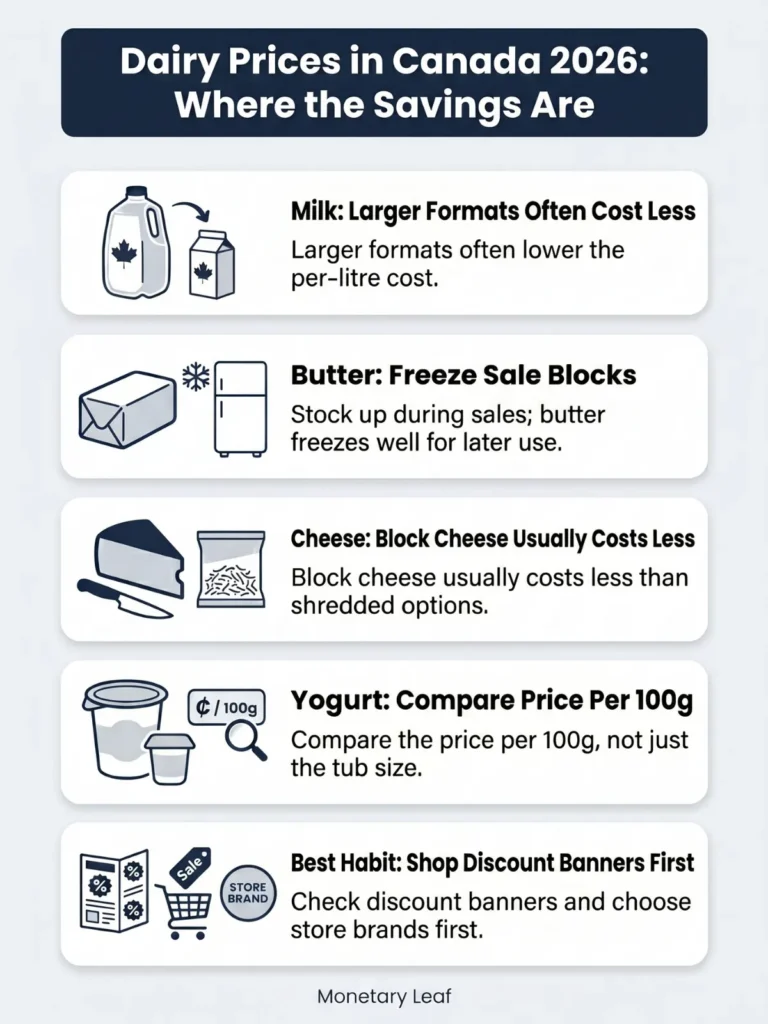
There’s no way around the structural cost of Canadian dairy, but these tactics can cut your monthly spending by a meaningful amount:
- Switch to store brands. A 454g block of No Name butter at Loblaws costs $6.19. Gay Lea butter at Walmart costs $7.96. Great Value butter regularly sells for $5.96 and drops to $4.97 on rollback, a 37% discount over the national brand. The same pattern holds for cheese: No Name Medium Cheddar at No Frills is $5.99 for 400g, versus $8.00 for Armstrong, a 25% saving.
- Buy block cheese, not shredded. A 700g block of No Name Cheddar runs $8.79 ($1.26 per 100g). A 400g bag of Armstrong shredded cheese costs $8.00 ($2.00 per 100g). Shredding it yourself saves roughly 37% per unit.
- Buy the larger format. At Walmart, Natrel 2% milk costs $7.18 for 4L ($1.80 per litre) versus $5.83 for 2L ($2.91 per litre). That’s a 38% per-litre discount just for buying the bigger bag.
- Freeze butter when it goes on sale. Butter freezes well for up to twelve months. When Sobeys marks Compliments butter down to $5.00 or Walmart drops Great Value to $4.97, buy several blocks and freeze them. You’re locking in prices that may not come back for weeks.
- Use the Flashfood app for near-expiry dairy. Flashfood partners with Loblaws-owned stores (No Frills, Real Canadian Superstore, Loblaws) to sell dairy approaching its best-before date at steep discounts. Observed purchases in March 2026 included 4L of skim milk for $3.59 (originally $7.18) and 4L of 1% lactose-free milk for $4.00 (originally $11.15). That’s 50% or more off.
- Shop discount banners consistently. No Frills recorded the lowest single price for 2L of 2% milk at $2.77. Discount banners reliably undercut conventional supermarkets on baseline dairy pricing, even before flyer sales.
Calculate Your Own Dairy Savings
National averages are useful, but your real savings depend on the prices you see in your own grocery store. Use the Dairy Aisle Savings Calculator Canada below to compare milk, butter, cheese, and yogurt by unit price and estimate how much different buying choices may change your monthly grocery bill.
Dairy Aisle Savings Calculator Canada
Dairy Aisle Savings Calculator Canada
Compare milk, butter, cheese, and yogurt by unit price and estimate possible monthly savings.
Quick Unit Price Checker
Use this first when you only want to compare one dairy package by litre or by one hundred grams.
Milk
Butter
Cheese
Yogurt
Your estimated dairy savings
Current monthly cost:
Better-value monthly cost:
Estimated monthly savings:
Estimated yearly savings:
This calculator is for educational use only. Grocery prices vary by province, store, package size, sale cycle, and household habits.
Key Facts: Key Canadian Dairy Price Facts (2026)
- National 4L Milk Average: $7.07 ($1.77 per litre).
- Cumulative Five-Year Increase: Milk prices have risen by roughly 27% since 2021.
- Farmgate Price Shift: The Canadian Dairy Commission enacted a 2.33% increase on February 1, 2026.
- Regional Peak: Charlottetown, PEI, experiences the highest pricing at $2.31 per litre.
- Regional Floor: Ontario and the Prairies have the lowest average prices at approximately $1.60 per litre.
- Cross-Border Gap: Canadian milk averages 27% more expensive than currency-adjusted U.S. Walmart options.
Dairy is a fixed cost most Canadian families can’t eliminate. The same fixed-cost pressure shows up in ground beef prices, chicken, eggs, and other everyday proteins. Dairy prices Canada 2026 are not coming down in any structural way, and the supply management system ensures a high baseline. The practical response is store brands, larger formats, sale timing, and discount banners. Small, repeatable tactics. That’s where the savings live.
Frequently Asked Questions
How much does milk cost in Canada in 2026?
The national average price for a 4L bag of 2% milk is $7.07, or about $1.77 per litre, according to the Field Agent Canada Fluid Milk Report published in April 2026. Prices range from around $1.60 per litre in Ontario and the Prairies to $2.31 per litre in Charlottetown, PEI
Why is dairy more expensive in Canada than the United States?
Canada uses a supply management system that sets a regulated minimum price at the farm level, restricts domestic production through quotas, and blocks cheap foreign imports with high tariffs. This keeps Canadian dairy prices structurally higher. A 2026 cross-border audit found Canadian milk prices were roughly 27% above U.S. Walmart prices after currency adjustment.
Did dairy prices go up in 2026?
Yes. The Canadian Dairy Commission raised the farmgate price by 2.33% on February 1, 2026, adding just over 2 cents per litre at the farm level. Retail milk prices have risen by about 5.5% since mid-2024, outpacing the farmgate increase and suggesting that retail margins and shipping costs are contributing to the gap.
What is supply management and how does it affect dairy prices?
Supply management is a federal regulatory system governing dairy, poultry, and eggs in Canada since the 1970s. It controls production through farm quotas, limits imports through tariffs, and guarantees a minimum price to farmers. The result is stable incomes for producers but higher and more predictable consumer prices compared to open-market countries.
Which grocery store has the cheapest dairy in Canada?
Discount banners like No Frills consistently offer the lowest baseline dairy prices. No Frills recorded the cheapest 2L milk price at $2.77, and its flyer sales regularly bring 4L bags down to $4.98. Shopping flyer sales and discount banners is the most reliable way to reduce your dairy costs.
Can you freeze butter to save money?
Yes. Butter freezes safely for up to twelve months without significant quality loss. Buying store-brand butter on sale (such as Compliments at $5.00 or Great Value at $4.97 per 454g block) and freezing several blocks at once is one of the simplest ways to lock in a lower price and reduce your grocery bill over time.
All dollar amounts in this article are in Canadian dollars unless otherwise noted.
Disclaimer:
This article is for informational and educational purposes only and does not constitute financial, legal, tax, or investment advice. Individual circumstances vary, so please use your own judgment and consult a qualified professional when appropriate.